Most grooming appointments go fine. The cases that don’t are almost always tied to one of two things: a restraint left unattended, or a dryer left running unsupervised, and both are entirely preventable once you know what to look for. For the broader picture across every safety category, see Dog Safety: The Complete Guide, and for grooming fundamentals generally, see Dog Grooming: The Complete Guide.
The Restraint Loop Is the Single Biggest Risk
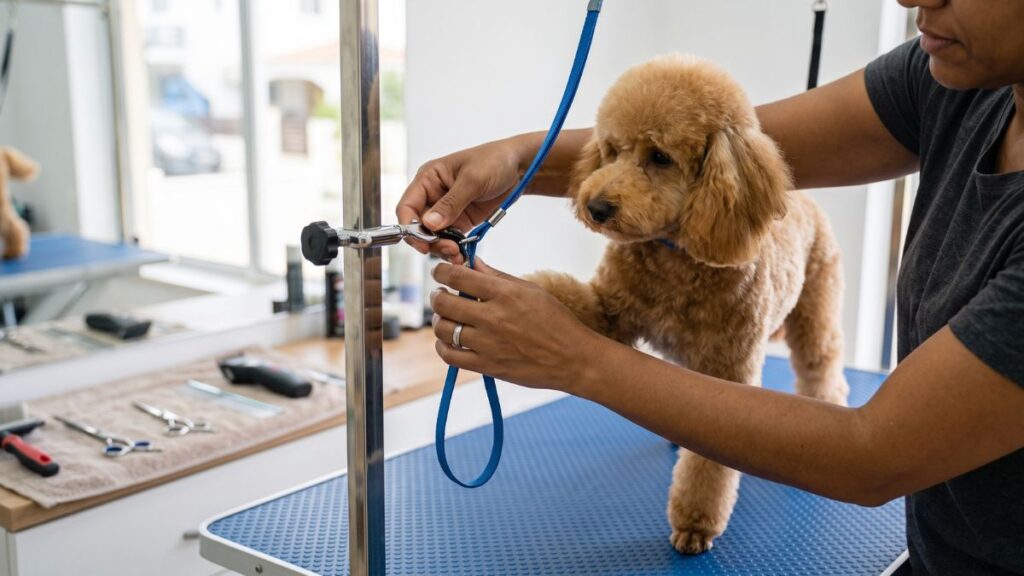
Most grooming tables use a loop, sometimes called a grooming noose, that goes around a dog’s neck and clips to an overhead arm to keep them from wandering off the table while being groomed.
Left alone, that same loop becomes a genuine hanging hazard. If a dog jumps, slips, or loses its footing while unattended, the loop can tighten around the neck with the dog’s own body weight, and there’s no one there to release it in time. Documented cases include a corgi named Fendi, whose groomer in Singapore was fined after leaving him restrained and unattended for 45 minutes in 2024, and a toy poodle named Kobe, who died at a Pennsylvania PetSmart in 2020 after being tethered with two loops pulling in opposite directions during a routine nail trim.
There’s no single government body tracking grooming deaths nationally, so there’s no reliable overall count. What does exist is a pattern of individual, well-documented cases, compiled by organizations like PETA, that all trace back to the same root cause: a restrained dog left without anyone watching.
The Fix the Industry Already Has: Quick-Release, Never Unattended
A proper grooming loop should include a quick-release “panic snap” that lets a groomer free a dog in seconds, not a knot or a fixed clip that takes time to undo.
Many experienced groomers use a two-point restraint system (sold under names like Groomer’s Helper) rather than a single neck loop alone. It keeps pressure off the trachea and limits how much a dog can twist, slip, or dance around on the table, which is exactly the movement that leads to a fall in the first place.
None of this replaces the actual rule that matters most: a restrained dog should never be left alone, even for a minute, even to answer a phone or grab a tool from another room.
Cage Dryers Are the Other Major Risk
Cage dryers, forced-air dryers built into a kennel-style cage, are convenient for a busy salon since they let a groomer dry several dogs at once without standing over each one. Left running unsupervised or malfunctioning, the temperature inside can climb into a genuinely dangerous range, with PETA citing air temperatures reaching up to 135°F in some documented incidents.
Real cases include two Yorkshire Terriers who died at a Connecticut salon when a dryer failed to shut off, and a Newfoundland, a breed already sensitive to heat, whose temperature had climbed past 109°F with organ failure underway by the time she collapsed after being picked up “dry.”
A dog left in a cage dryer can’t move away from the heat or signal distress the way they could with a handheld dryer and a person right there watching.
What to Ask a Groomer Before You Book
Ask directly whether a dog is ever left alone while restrained on the table, even briefly, and whether staff stay within arm’s reach the entire time a dog is tethered.
Ask specifically whether they use cage dryers, and if so, whether a person is actively present and checking on the dog throughout, not just walking past periodically.
Ask what their restraint setup actually looks like: a single loop, a two-point system, or something else, and whether it includes a genuine quick-release mechanism.
A groomer confident in their process will usually answer these questions directly and without hesitation. Hesitation or vague reassurance is worth treating as a real signal.
Warning Signs at Pickup
Labored or noisy breathing, an unsteady or wobbly walk, visible marks or hair loss around the neck, and disorientation are all signs worth taking seriously and raising immediately, not waiting to see if they pass.
If your dog seems “off” in any way after a grooming appointment, treat it as worth an urgent vet check rather than assuming it will resolve on its own, particularly following any drying or restraint-heavy service like a full groom or nail trim.
Grooming at Home: The Same Rules Apply
If you use any kind of grooming table, arm, or loop at home, the same core rule holds: never leave your dog restrained and unattended, even to step away for a moment.
Choose a loop or tether with a real quick-release clip, not a fixed knot you’d need time to undo in an emergency.
Skip unsupervised cage-style drying at home entirely. A handheld dryer on a cool or low setting, used while you’re right there watching your dog’s reaction, is the safer default.
Common Mistakes
Assuming a “just a few minutes” absence is safe. Multiple documented deaths happened in exactly that window, not over hours.
Not asking about cage dryer supervision before booking. This is a reasonable, normal question, and a groomer’s answer tells you a lot.
Ignoring a wobbly walk or hoarse breathing after pickup. These are exactly the signs that preceded several documented incidents.
Using a fixed knot instead of a quick-release clip for home grooming. Seconds matter if something goes wrong, and a knot costs you those seconds.
FAQ
Is it normal for a groomer to leave my dog alone briefly during an appointment?
Not while restrained. A dog secured in a loop or tether should have someone within arm’s reach the entire time, even for a short absence.
Are cage dryers always dangerous?
Not inherently, but they carry real risk without active supervision. Ask whether a person is actively monitoring, not just periodically checking in.
What should I do if I suspect something went wrong during my dog’s grooming appointment?
Get your dog checked by a vet promptly, and request to see any available footage from the salon if you have concerns, which many facilities are required to provide.
Is a single grooming loop unsafe on its own?
It can work safely with constant supervision and a genuine quick-release clip. The danger comes from being left unattended, not the loop itself.
The Bottom Line
Nearly every serious grooming incident traces back to one of two things: a restrained dog left unattended, or a dryer left running unsupervised. Asking the right questions before you book, and watching for warning signs afterward, addresses almost all of the real risk. For the broader picture across every safety category, head back to Dog Safety: The Complete Guide.