Asian Fusion has a specific origin story most owners have never heard: the name itself was coined in 2007 by British groomer Pammie Carmichael Hogg to describe the distinctive Eastern grooming techniques she’d encountered. For the full picture on grooming styles, see Dog Grooming Styles: A Complete Guide.
What Actually Defines Asian Fusion
Three core principles separate it from traditional grooming: rounded shapes over sharp lines, soft volume over sleek clipping, and a body trimmed short to create deliberate contrast against fuller, fluffier sections at the face, ears, and legs.
Traditional Western grooming works toward a breed’s defined standard, a Poodle should look like a Poodle, following rules set by kennel clubs. Asian Fusion throws that rulebook out entirely and sculpts around a dog’s individual personality instead.
Where It Comes From
The technique traces back to salons in Japan, Korea, China, Taiwan, Thailand, and Malaysia, all cities where limited living space made small dog breeds especially popular, which in turn shaped a grooming aesthetic built around cute, rounded proportions rather than working-dog practicality.
Signature Elements
A short, smooth-clipped body, especially in areas prone to matting, paired with a fluffy, rounded face and full, flared legs. The face is a major focal point, carefully shaped around the eyes and muzzle for a cute, expressive look.
Tails are often styled into distinct shapes, pom-poms, hearts, or even flower-like forms, and elements like braids, bows, hats, and accessories are commonly incorporated in a way traditional Western grooming rarely uses.
Color is a frequent addition too, applied to ears, tails, feet, or occasionally the whole body using pet-safe dye. See Creative Dog Grooming: Dye and Styling Trends for safe application.
Which Breeds Suit It Best
It works on any breed in principle, but lends itself especially well to smaller dogs with dense, curly coats, like Poodles, Bichons, and Shih Tzus, since their coat holds the rounded shapes reliably. Long, silky-coated breeds can lean into a sleeker version of the same aesthetic instead.
What It Takes to Achieve
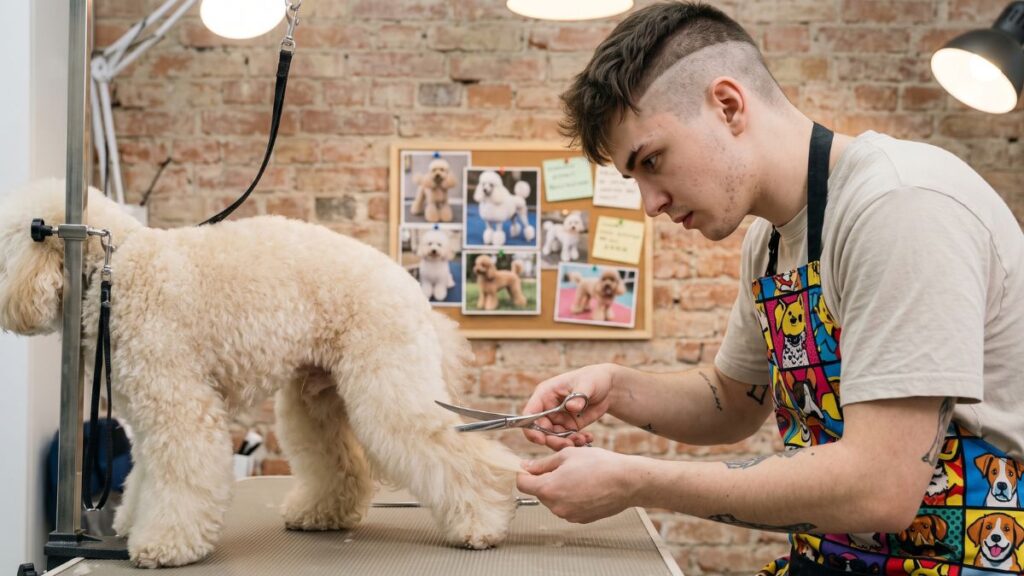
This is genuinely skilled work, requiring specialized training beyond a standard grooming background. The scissor work alone, cutting at careful angles to build soft curves rather than straight lines, takes real time to learn well.
Expect a shorter interval between grooms than a standard pet clip, since the precise shaping and contrast between short and full sections grows out faster than a uniform length would.
Common Mistakes
Assuming any groomer can deliver Asian Fusion results without specific training. This style needs dedicated technique training beyond general grooming experience.
Choosing it for a breed with a straight, thin coat expecting the same volume. Dense, curly coats hold the signature rounded shapes far more reliably.
Treating it as a single fixed look. Asian Fusion is a philosophy and technique set, not one specific haircut.
FAQ
Is Asian Fusion the same as a Teddy Bear Cut?
A Teddy Bear Cut is one specific result that Asian Fusion techniques commonly produce, but the broader style includes far more variation: tail shaping, accessories, color, and asymmetric elements.
Does Asian Fusion work on large breeds?
It can, though the technique is most commonly applied to and most closely associated with smaller breeds.
Who invented Asian Fusion?
The technique developed organically across salons in Japan, Korea, China, and neighboring countries; the term “Asian Fusion” itself was coined in 2007 by British groomer Pammie Carmichael Hogg.
The Bottom Line
Asian Fusion is a genuine technique and philosophy, built on rounded shapes and personality-driven styling, that takes real specialized skill to execute well. For more grooming styles, head back to Dog Grooming Styles: A Complete Guide.