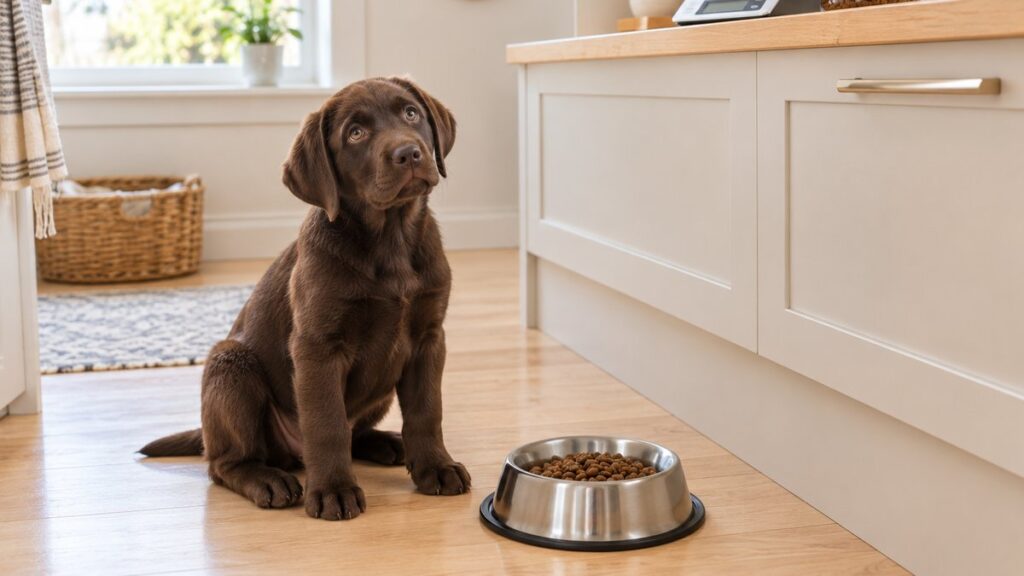
Breakfast goes down at 7am. By 7:20 your puppy is sniffing and circling the kitchen floor.
That isn’t bad luck. What goes in on a schedule comes out on a schedule.
Feed at random times, and every potty break turns into a guess, with an accident wherever you guessed wrong.
Feed too few meals, and a small puppy stomach gets overloaded. That means loose stools, a hungry puppy between meals and, in toy breeds, a real risk of low blood sugar.
The rule is simple: feed set meals at the same times every day, more often while your puppy is young, and drop a meal as they grow.
Use this quick guide to see where your puppy is now:
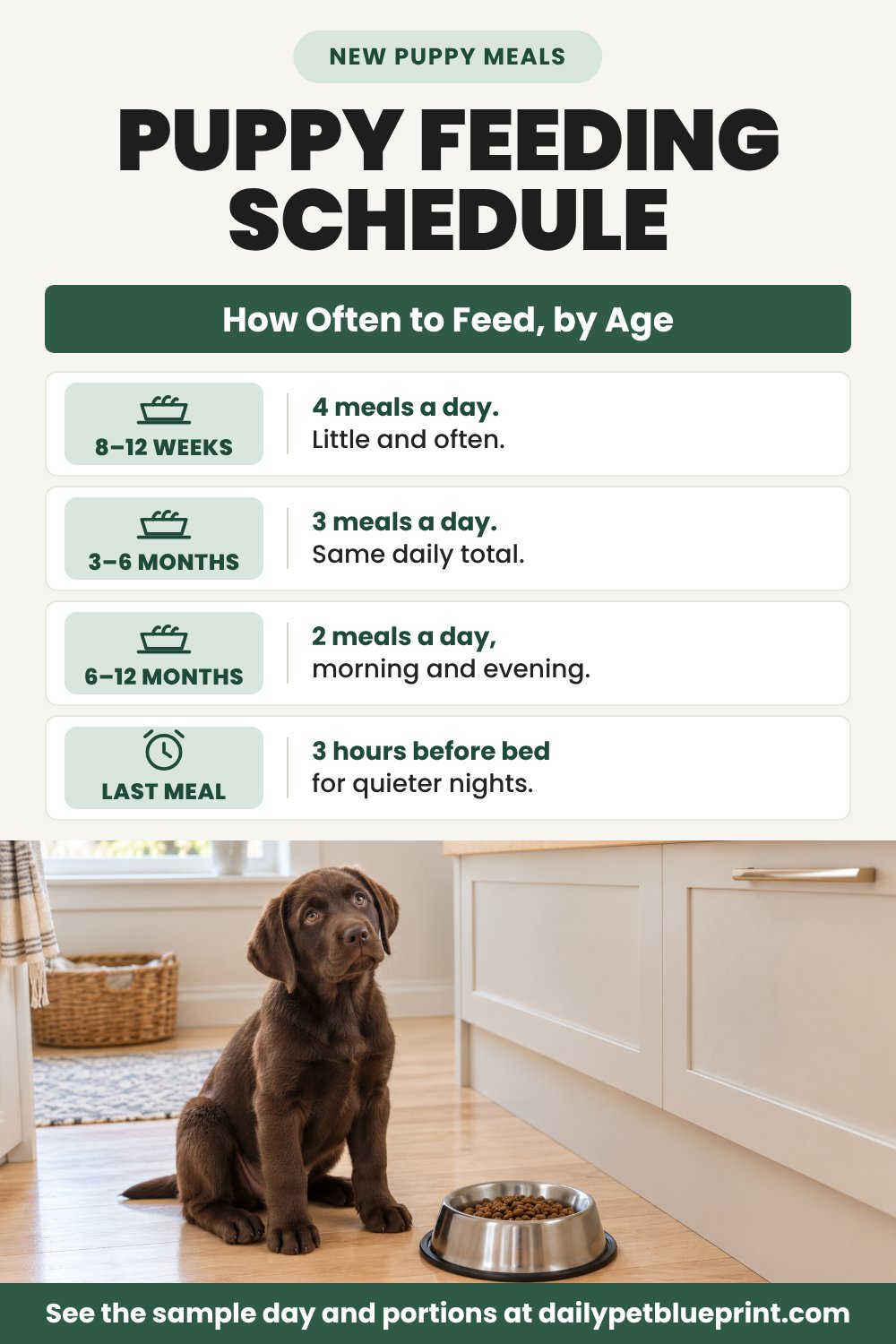
Age: 8 to 12 weeks | Meals: 4 a day | Example times: 7am, 11am, 3pm, 6pm
Age: 3 to 6 months | Meals: 3 a day | Example times: 7am, 12pm, 5pm
Age: 6 to 12 months | Meals: 2 a day | Example times: 7am, 5pm
Age: 12 months and up | Meals: 2 a day | Food: switch to adult food when your puppy is fully grown (later for large and giant breeds)
Toy breeds: keep 3 or 4 small meals a day for longer than other puppies, and never skip a meal
The times matter almost as much as the number of meals, because they decide when your puppy needs to go out. That’s where we’ll start.
Why a Feeding Schedule Makes Potty Training Easier
Eating gets a puppy’s gut moving. Most puppies need to poop somewhere between 5 and 30 minutes after a meal, so a fixed mealtime gives you a fixed potty time.
That’s the whole trick. If breakfast is always at 7am, you know you’ll be standing in the yard by 7:15. If breakfast happens whenever you remember, so does the accident.
Three habits that make it work:
- Take your puppy out straight after every meal. Stay out with them until they’ve been, then praise and come back in.
- Make the last meal about 3 hours before bedtime. That gives your puppy time to digest and go before you put them to bed, so they’re not waking you at midnight to poop.
- Pick up the water bowl about 2 hours before bed. Water should be available all day. Lifting it in the evening just means a fuller bladder isn’t waking them in the night. On a hot evening, offer a small drink at the last potty trip.
For how often your puppy needs to go out between meals, see the Puppy Potty Training Schedule by Age.
Free · Interactive 7-day plan
Get the free First Week Puppy Plan
A day-by-day plan for your puppy’s first seven days at home: the first night, the crate routine and potty breaks. Tick off each day as you go, and get a short email with tips for the tricky bits.
Puppy Feeding Schedule by Age
8 to 12 Weeks: 4 Meals a Day
Young puppies have small stomachs and burn through energy fast, so they need little and often. Four meals spread evenly through the day keeps their energy steady and their stools firm.
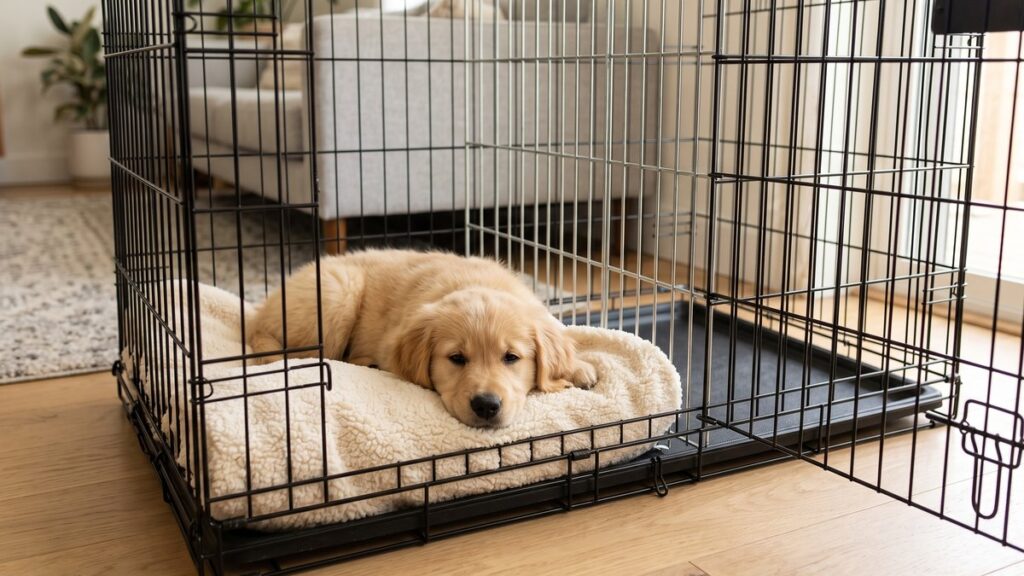
This is also the age where feeding helps with crate training. Putting each meal in the crate teaches your puppy that the crate is where good things happen.
3 to 6 Months: 3 Meals a Day
Somewhere around 12 weeks, most puppies start leaving food in one of their bowls, often the midday one, or eat it slowly without much interest. That’s usually the sign they’re ready to drop to three meals.
Don’t cut the daily amount when you drop a meal. Your puppy is still growing fast, so the same total goes into fewer, bigger meals.
6 to 12 Months: 2 Meals a Day
By around 6 months, most puppies can move to two meals, morning and evening. Again, it’s the same daily amount split into two.
Small and toy breeds can need a third meal for longer. If your puppy gets tired, shaky or picky when meals are spaced out, keep three meals going and ask your vet when to change.
When to Switch to Adult Food
Puppy food has extra calories and nutrients for growing. Switch to adult food once your puppy is close to their adult size, which depends on how big they’ll get:
Small breeds: usually around 9 to 12 months
Medium breeds: usually around 12 months
Large and giant breeds: usually somewhere between 12 and 24 months, as they keep growing for longer
Your vet can tell you the right time for your puppy. When you do switch, mix the new food in gradually over 7 to 10 days so you don’t upset their stomach.
How Much to Feed Your Puppy
Start with the feeding guide on your puppy food. It gives a daily total based on your puppy’s age and either their current weight or expected adult weight. Split that total across the number of meals for their age.
If you don’t know your puppy’s expected adult weight, our Puppy Weight Calculator will give you an estimate.
The bag is a starting point, not a rule. Puppies vary, so check their body every couple of weeks and adjust:
- Just right: you can feel their ribs easily under a thin layer, and you can see a waist when you look down from above.
- Too thin: ribs, spine or hip bones are easy to see. Increase the daily amount a little.
- Too much: you have to press to feel the ribs, and there’s no waist. Cut back a little.
Weigh the food, don’t scoop it. A cheap kitchen scale is far more accurate than a cup, and small differences add up quickly in a small puppy.
Count the treats. Treats and chews should be no more than about 10% of your puppy’s daily food. During training sessions, use kibble from their daily allowance as rewards so they don’t end up overfed.
A Sample Feeding Day for an 8-Week-Old Puppy
Here’s how four meals fit around a normal day. Shift the times to suit your household, but keep them the same every day.
7:00am: Wake up and straight outside. Breakfast in the crate, then back outside.
11:00am: Second meal, then outside. A nap afterwards is normal.
3:00pm: Third meal, then outside.
6:00pm: Last meal of the day, then outside.
8:00pm: Water bowl comes up. Calm evening play and a final potty trip before bed.
9:00 to 10:00pm: Last potty trip and bed.
For the full day, including naps, play and training, see the Puppy Daily Schedule for an 8 Week Old.
Large Breed and Toy Breed Puppies
Large and Giant Breed Puppies
Big puppies need careful growth, not fast growth. Feeding too much, or a food with too much calcium, can push them to grow too quickly, which is linked to joint problems later on.
Choose a food labeled for large-breed puppies, stick to the daily amount and keep them lean. A slightly slim large-breed puppy is healthier than a chunky one.
Wait about an hour after a meal before energetic play or a long walk, and don’t let them gulp a huge meal all at once. Deep-chested breeds are at higher risk of bloat, a serious emergency, and splitting food into several meals helps.
Toy Breed Puppies
Tiny puppies like Chihuahuas, Yorkies and Toy Poodles have very little energy in reserve, and their blood sugar can drop if they go too long without food. Keep meals small and frequent, and don’t skip one.
If a toy breed puppy is suddenly weak, wobbly, trembling or very sleepy, especially after missing a meal, call your vet straight away.
Common Puppy Feeding Mistakes
Leaving food down all day. Free feeding makes it impossible to predict potty times, and it’s hard to tell when your puppy is off their food. Pick up the bowl after 15 to 20 minutes.
A late dinner. A meal at 9pm almost guarantees a middle-of-the-night poop. Keep the last meal about 3 hours before bed.
Changing food suddenly. A sudden switch is one of the most common causes of upset stomachs in new puppies. Keep them on the breeder’s or rescue’s food for the first week or two, then change gradually over 7 to 10 days if you want to.
Forgetting the treats. Chews, training treats and bits from the table add up fast. Count them as part of the day’s food.
Dropping meals too early. Going from four meals to two at 10 weeks often means loose stools and a hungry, nippy puppy. Follow the age guide and let your puppy show you when they’re ready.
Frequently Asked Questions
How many times a day should I feed my puppy?
Four meals a day from 8 to 12 weeks, three from 3 to 6 months, and two from around 6 months. Toy breeds may need extra meals for longer.
What time should I feed my puppy their last meal?
About 3 hours before bedtime. That gives them time to digest and go potty before bed, which means fewer night wake-ups.
Should I wet my puppy’s kibble?
You can. Soaking kibble in a little warm water for a few minutes can help very young puppies or puppies who are teething. Throw away anything left after the meal, as soaked food spoils quickly.
Is it normal for my puppy to skip a meal?
Puppies sometimes leave a meal, especially when they’re ready to drop to fewer meals or are teething. If your puppy refuses more than one meal in a row, seems unwell, or has vomiting or diarrhea, call your vet. Toy breed puppies shouldn’t miss meals at all.
Should I feed my puppy before or after a walk?
After is usually better. Give them about an hour after eating before energetic exercise, especially large and deep-chested breeds.
Can I give my puppy human food?
Small amounts of some plain foods are fine as treats, but some are dangerous. Check our Toxic Food Calculator before sharing anything from your plate.
The Bottom Line
Feed set meals at the same times every day: four meals until 12 weeks, three until 6 months, then two. Take your puppy out straight after every meal, keep the last meal about 3 hours before bed, and adjust the amount by their body, not just the bag. A predictable feeding schedule is one of the easiest ways to make potty training faster.
Once meals are on a schedule, you can teach your puppy to tell you when they need to go out: Potty Training a Puppy With Bells: How to Teach Your Puppy to Ring to Go Out.
Your New Puppy Journey
Puppy Potty Training & Crate Training
Crate training first, then potty training, in the order you’ll need them.
Start hereChoose the right crate →See all steps
Crate Training
- What Size Crate for a Puppy?
- First Night With a New Puppy
- Why Does My Puppy Cry at Night?
- How to Crate Train a Puppy: The 5-Day Method
- Puppy Crate Training Tips
- What to Do When Your Puppy Cries or Whines in the Crate
- When to Stop Crate Training
Potty Training
- Puppy Potty Training Routine
- Puppy Potty Training Schedule by Age
- Puppy Feeding Schedule by Age
- Potty Training a Puppy With Bells
- Potty Training an Apartment Dog
- How to Stop Your Puppy Peeing in the House
- Potty Training Regression
More for New Puppy Owners
Free · Interactive 7-day plan
Get the free First Week Puppy Plan
A day-by-day plan for your puppy's first seven days at home: the first night, the crate routine and potty breaks. Tick off each day as you go, and get a short email with tips for the tricky bits.