Crate training works so well that it is easy to keep the door shut out of habit long after your puppy needs it. Stop too soon, however, and you return home to chewed baseboards and house-training regression.
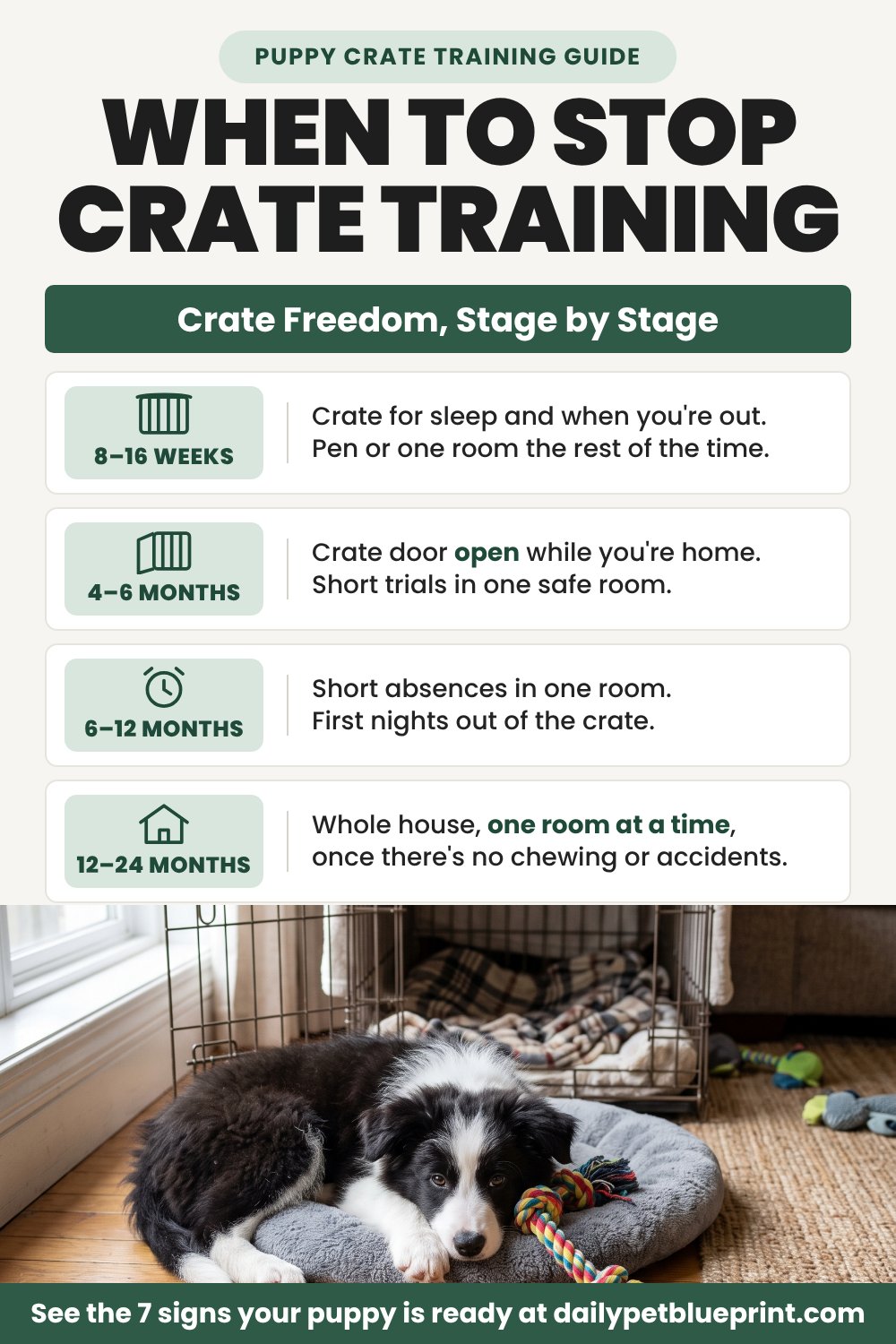
Crate freedom is not an arbitrary date on the calendar. While most dogs do not earn unsupervised run of the entire house until 12 to 24 months, freedom is earned in progressive phases—starting with a single puppy-proofed room long before you retire the crate entirely.
Before unlatching the door for good, use this general readiness progression to gauge where your puppy currently stands:
Freedom Phase: Gated Safe Room (6–9 Months) Readiness Test: 30–60 minutes alone with zero destructive chewing or accidents.
Freedom Phase: Overnight Freedom (9–12 Months) Readiness Test: Sleeps calmly through the night in a closed bedroom without pacing.
Freedom Phase: Short Solitary Stretches (12–18 Months) Readiness Test: Left loose for 2 to 4 hours with reliable toy redirection.
Freedom Phase: Full House Access (18–24 Months) Readiness Test: Adult emotional maturity; zero boundary testing while you are away.
7 Signs Your Puppy Is Ready for More Freedom
Age is only a rough guide. These signs tell you far more about your own puppy. You want to see most of them, not just one or two.
1. No Accidents in the House for at Least a Month
Not “hardly any”. None. A puppy who still has the odd accident isn’t fully house trained, and more space only gives them more places to go. Six to eight weeks without one is even better before you leave them loose while you’re out.
If accidents have crept back in after a good spell, see Potty Training Regression before giving any more freedom.
2. They Only Chew Their Own Things
When you’re in the room, do they head for their chews or for your shoes, the TV remote and the corner of the sofa? A puppy who still goes for household items when you’re watching will go for them faster when you’re not.
Bear in mind most puppies have their adult teeth by around 6 months, but many go through a second chewing phase between about 6 and 12 months as their jaws settle. Freedom often goes wrong right in the middle of that phase.
3. They Settle When You Leave the Room
Walk into the kitchen for five minutes. A ready puppy stays where they are or lies down. A puppy who isn’t ready follows you, cries at the door, or uses the time to investigate the bin.
4. They Sleep Through the Night Quietly
A puppy who still wakes at 3am needing the toilet isn’t ready to sleep loose. Wait until they’re sleeping a full night in the crate without crying or accidents for a few weeks first.
5. They Go Into the Crate by Themselves
This sounds like the opposite of a sign they’re ready, but it’s one of the best. A puppy who takes themselves off to the crate for a nap has learned to rest on their own, which is exactly what they’ll need to do with the run of the house.
6. They Can Be Left in a Pen or Small Room Without Trouble
Before the whole house, there should be a step in between. If your puppy can be left in a playpen or one puppy-proofed room for an hour and you come back to nothing chewed, nothing wet and a calm dog, that’s a strong sign.
7. They Can Switch Off
Some puppies can’t stop. They pace, look for something to do and get into trouble when they’re bored. A ready puppy can lie down and rest when nothing’s happening, without you having to put them in the crate to make it happen.
Free · Interactive 7-day plan
Get the free First Week Puppy Plan
A day-by-day plan for your puppy’s first seven days at home: the first night, the crate routine and potty breaks. Tick off each day as you go, and get a short email with tips for the tricky bits.
Signs Your Puppy Isn’t Ready Yet
- Accidents in the last few weeks, even small ones
- Chewing household items, cables or furniture, even with you there
- Crying, barking or scratching at the door when you leave the room
- Stealing food from counters or raiding the bin
- Still waking at night to go to the toilet
- Signs of separation distress, like drooling, panting or frantic scratching when left
None of these mean anything’s gone wrong. They just mean the crate is still doing an important job, so keep using it for a few more weeks and check again.
How to Move From Crate to Freedom, Step by Step
The safest way is to widen your puppy’s world in stages, only moving on when the current stage is going well. Each stage usually takes a couple of weeks. Some puppies move faster, and that’s fine.
Stage 1: Crate Door Open While You’re Home
Leave the crate door open during the day while you’re in the house. Your puppy can come and go, and you can see what they do with that choice. Many will keep using the crate for naps.
Stage 2: Crate Inside a Pen or One Safe Room
Put the open crate inside a playpen, or in a room you’ve puppy-proofed, usually the kitchen or a utility room with a hard floor. Your puppy gets more space, but still a small, safe area.
Stage 3: Short Absences in That Space
Leave your puppy in the pen or room while you pop out. Start with 10 to 15 minutes, then build up:
- 10 to 15 minutes (a walk round the block)
- 30 minutes
- 1 hour
- 2 hours
- A normal morning or afternoon out
Take your puppy out to the toilet right before you leave, and give them a stuffed rubber toy or long-lasting chew to settle with. Move up a step only after several trips at the current length go well.
A cheap pet camera or an old phone on a video call makes this much easier. You’ll see whether your puppy settles in five minutes or spends the whole hour crying at the door, which you can’t tell from the state of the room alone.
Stage 4: Nights Out of the Crate
Nights are often easier than days, because your puppy is tired and you’re right there. When they’ve been sleeping through quietly for a few weeks:
- Put a dog bed where the crate used to be, or right next to it with the crate door left open.
- Close the bedroom door so your puppy can’t wander the house at 3am.
- Clear the floor of socks, chargers and anything chewable.
- Keep the same bedtime routine, including the last toilet trip.
If they wake and start exploring, or you find an accident in the morning, go back to the crate at night for a couple more weeks and try again.
Stage 5: One Room at a Time
Once your puppy is reliable in one room while you’re out, open up one more, using baby gates to close off the rest. Add rooms every few weeks. Upstairs, bedrooms and rooms with carpets usually come last.
Puppy-Proof Before You Open Up a Room
Get down to your puppy’s height and check every room before it becomes part of their space:
- Cables tucked away or covered
- Shoes, bags and laundry off the floor
- Bin lidded or behind a closed door
- Nothing edible on low tables or counters
- Medication, chocolate, sugar-free gum and grapes well out of reach
- Houseplants moved up or out
- Water bowl and their own chews left out
Not sure which foods are the dangerous ones? Check our Toxic Food Calculator.
What to Do If Things Go Wrong
Setbacks are normal, especially in teenage dogs. If you come home to a chewed cushion or an accident:
- Don’t tell your puppy off. They can’t link it to something they did an hour ago. They’ll only learn that your coming home is stressful.
- Clean up and step back one stage. If the whole house went wrong, go back to one room. If one room went wrong, go back to the pen.
- Look for the cause. Were they out too long? Did they miss a walk? Was something new and tempting left out?
- Try again in a week or two. Shorter absences, more exercise before you leave, and a good chew to keep them busy.
If your puppy seems frightened rather than bored when left, with drooling, panting, howling or scratching at doors, that’s separation distress rather than a freedom problem. Go back to shorter absences and talk to your vet or a qualified trainer if it doesn’t ease.
Keep the Crate, Even After Freedom
Crate freedom doesn’t have to mean the crate goes in the loft. Leave it up with the door open, and most dogs will keep using it as a bed. It’s also worth keeping your dog comfortable in a crate for life, because there’ll be times they need one:
- Vet stays and recovery after surgery
- Car journeys (see Using a Crate for Travel and Car Rides)
- Hotels and staying with family
- Visitors, builders, or a busy day when the front door keeps opening
- Fireworks night, when many dogs want a small, covered space to hide in
A short crate nap now and then, even after your dog has the run of the house, keeps it feeling normal rather than like a punishment.
Common Mistakes
Going straight from crate to the whole house. This is the most common way freedom fails. Too many rooms at once means too many things to chew and too many corners to wee in.
Choosing a date instead of watching the dog. “They’re a year old now” isn’t a reason. A reliable, calm dog is.
Starting with a long absence. The first time your puppy is loose shouldn’t be a full working day.
Forgetting exercise. A puppy left loose after a lazy morning has energy to burn. A walk and a sniff before you leave makes a huge difference.
Taking the crate away completely. You lose a safe space your dog may still want, and you’ll have to retrain it when you next need it.
Giving freedom in the middle of the teenage chewing phase. If your 8-month-old has just started chewing again, it’s not the week to open up the living room.
Frequently Asked Questions
What age can a puppy sleep out of the crate?
Many puppies can start sleeping out of the crate in your bedroom somewhere between 6 and 12 months, once they’re fully house trained, sleeping through the night and not chewing. Every puppy is different, so watch for the signs rather than the birthday.
Can I stop using the crate completely?
You can, but it’s worth keeping one up with the door open. Most dogs keep using it to sleep, and it’s much easier to use for travel, vet visits or recovery if it’s still familiar.
My dog still chews things when I’m out. What should I do?
Go back a stage to a smaller, puppy-proofed space, add more exercise and a long-lasting chew before you leave, and shorten your absences for a while. Chewing when left is usually boredom or teething, and occasionally stress.
Is it unkind to keep crating an adult dog?
Not if the crate is a comfortable place they like and they aren’t shut in for long stretches. Plenty of adult dogs choose to sleep in an open crate. What matters is time out of it, exercise and company.
My dog wants to stay in the crate. Is that a problem?
No. It means the crate has become a safe, comfortable den, which is exactly what good crate training aims for. Leave the door open and let them choose.
The Bottom Line
Crate freedom comes in steps: door open while you’re home, then one safe room, then short absences, then nights, then the rest of the house. Move on only when your puppy shows you they’re ready, and step back without fuss when they’re not.
Crate freedom and house training go hand in hand, so the next step is a potty routine that holds up: Puppy Potty Training Routine: A Step-by-Step Daily Schedule.
Your New Puppy Journey
Puppy Potty Training & Crate Training
Crate training first, then potty training, in the order you’ll need them.
Start hereChoose the right crate →See all steps
Crate Training
- What Size Crate for a Puppy?
- First Night With a New Puppy
- Why Does My Puppy Cry at Night?
- How to Crate Train a Puppy: The 5-Day Method
- Puppy Crate Training Tips
- What to Do When Your Puppy Cries or Whines in the Crate
- When to Stop Crate Training
Potty Training
- Puppy Potty Training Routine
- Puppy Potty Training Schedule by Age
- Puppy Feeding Schedule by Age
- Potty Training a Puppy With Bells
- Potty Training an Apartment Dog
- How to Stop Your Puppy Peeing in the House
- Potty Training Regression
More for New Puppy Owners
Free · Interactive 7-day plan
Get the free First Week Puppy Plan
A day-by-day plan for your puppy's first seven days at home: the first night, the crate routine and potty breaks. Tick off each day as you go, and get a short email with tips for the tricky bits.