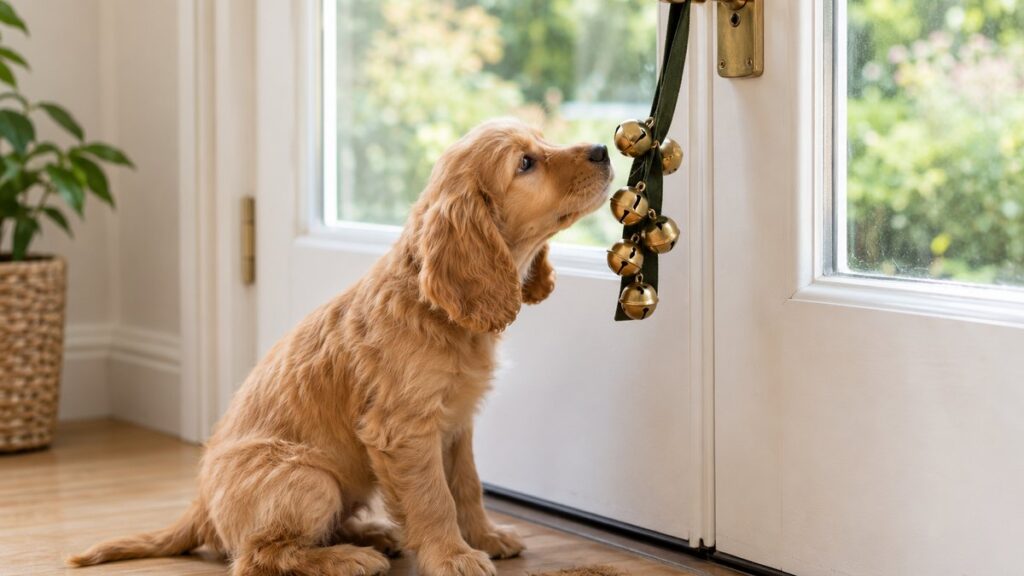
Your puppy is sitting by the back door, staring at it in total silence.
Two minutes later, there’s a puddle on the mat.
Most puppies do try to tell you they need to go. The trouble is you can’t hear a stare from the next room.
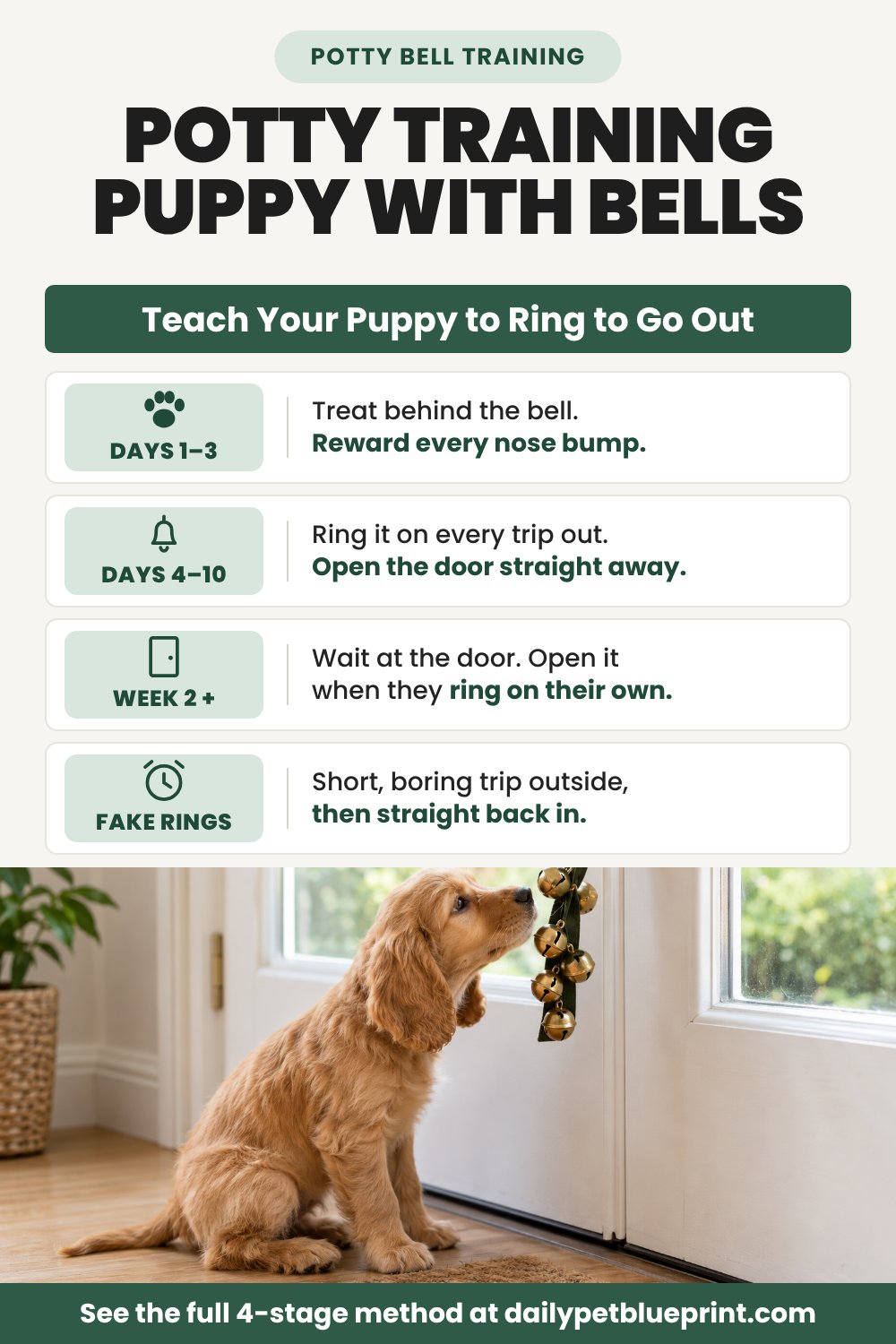
Potty training a puppy with a bell gives them a sound you can’t miss. It’s built in four simple stages, and most puppies are ringing on their own within a few weeks:
Stage 1: Touch the Bell | When: days 1 to 3 | Do This: hold a treat just behind the bell and reward every nose bump
Stage 2: Ring to Go Out | When: days 4 to 10 | Do This: ring it on every trip out, say “outside” and open the door straight away
Stage 3: Wait for Them | When: week 2 onward | Do This: pause at the door and open it the moment they ring on their own
Stage 4: Keep It Honest | When: ongoing | Do This: if they ring just for fun, keep the trip short and boring, then straight back in
Why Bell Training Works So Well for Puppies
Puppies learn cause and effect quickly, especially when the effect is something they want. Bells give them one simple action that always makes the door open.
It also takes the guesswork out of potty training for you. Instead of watching for subtle signs like sniffing or circling, you get a clear signal you can hear from anywhere in the house.
When to Start Bell Training Your Puppy
Start once your puppy understands that the toilet is outside. For most puppies that’s somewhere around 10 to 14 weeks, after a couple of weeks on a steady potty schedule.
Before that, an 8-week-old puppy simply needs to go too often, and too suddenly, to stop and ring first. In those early weeks, the schedule does the work. Our Puppy Potty Training Schedule by Age shows how often to take them out.
Choosing Puppy Potty Training Bells
You have two main options:
- Hanging strap bells. A strap of jingle bells that hangs from the door handle. Cheap, simple and the most popular choice.
- A puppy training door bell. A press button that sits on the floor or attaches to the wall and plays a chime when your puppy pushes it with a nose or paw. Good if you don’t want bells clanging every time the door opens.
Whichever you choose, hang or place it at your puppy’s nose height, so they can bump it without jumping. Move it up as they grow.
DIY Puppy Potty Training Bells
You can make your own with a strong strap or a piece of webbing and three or four large jingle bells. Sew or rivet the bells on firmly rather than tying them with string.
Puppies chew everything, and small bells that come loose can be swallowed. Whether you buy or make them, only use bells your puppy can’t pull apart, and don’t leave them where your puppy can chew them unsupervised.
Free · Interactive 7-day plan
Get the free First Week Puppy Plan
A day-by-day plan for your puppy’s first seven days at home: the first night, the crate routine and potty breaks. Tick off each day as you go, and get a short email with tips for the tricky bits.
Stage 1: Teach Your Puppy to Touch the Bell
Before the bell means anything, your puppy just needs to learn that touching it pays. Keep this stage completely separate from going outside.
- Hold a small, tasty treat just behind the bell.
- The moment your puppy’s nose bumps the bell to get to it, say “yes” and give them the treat.
- Repeat 5 or 6 times, then stop. Do two or three of these short sessions a day.
- Once they’re bumping it every time, start holding the treat a little further away so they touch the bell first and then get the reward.
Most puppies have this down within two or three days.
Stage 2: Ring the Bell Every Time You Go Out
Now the bell gets connected to the door. Every single time you take your puppy out for the toilet:
- Walk them to the door and encourage a touch of the bell, using a treat at first if you need to.
- As it rings, say your cue word, like “outside”.
- Open the door straight away and go to the toilet spot.
Bell rings, door opens. That’s the whole lesson. Keep it the same on every trip, including the middle-of-the-night ones, for about a week.
Stage 3: Wait for Your Puppy to Ring on Their Own
After a week or so of ringing it together, start pausing at the door for a few seconds before you help. Stand still and give them the chance to work it out.
The first time they ring by themselves, even by accident, open the door immediately and make a fuss of them outside once they’ve been. Fast, reliable follow-through is what makes the habit stick.
Keep taking them out at the usual times as well. Bells are an extra signal, not a replacement for the schedule.
Stage 4: When Your Puppy Rings Just for Fun
Almost every puppy discovers that the bell opens the door to the most exciting place they know. Expect some fake rings.
Don’t ignore them, because you can’t always tell which ones are real. Instead, make every bell trip strictly business:
- Leash on, straight to the toilet spot.
- Give them 2 or 3 minutes. No games, no wandering the yard.
- If they go, praise and a treat. If they don’t, straight back inside, calmly.
Keep playtime outside as a separate thing that starts with you, not the bell. Once ringing only ever leads to a boring toilet trip, the fake rings usually fade within a week or two.
Bell Training Puppy Tips
- Use one door. Pick the door you always use for toilet trips and keep the bell there.
- Get everyone on board. If one person opens the door to every ring and another ignores it, your puppy won’t know which rule is real.
- Listen out. A bell rung while you’re in another room with headphones on teaches nothing. In the early weeks, keep your puppy close enough that you’ll hear it.
- Living in an apartment? Hang the bell on your front door and treat a ring as “leash on, time to go down”. See Potty Training in an Apartment With No Yard.
- More than one puppy or dog? Teach one at a time. The second often picks it up faster just by watching.
What If Your Puppy Won’t Ring the Bell?
Go back to Stage 1 with tastier treats and shorter sessions, and check the bell is easy to reach and not too heavy to move. Some puppies are nervous of the noise at first, so try a quieter bell or the press-button type.
And if your puppy just doesn’t take to it after a few weeks, that’s fine. Bells are a helpful tool, not a requirement. A steady schedule and watching their body language works just as well.
Common Mistakes With Puppy Bell Potty Training
Skipping the touch stage. Hanging the bells and expecting your puppy to work them out on their own usually just leads to a confused puppy.
Not always opening the door. In the early weeks, every ring must open the door. If it only works sometimes, the link weakens fast.
Ringing it for them forever. If you never step back and wait, your puppy never learns to start it themselves.
Turning bell trips into playtime. That’s how you end up with a puppy who rings every ten minutes.
Frequently Asked Questions
How long does bell training take? Most puppies learn to touch the bell in a few days. Ringing it on their own to ask to go out usually takes a few weeks of steady practice.
What age can I start bell training my puppy? Once they understand that the toilet is outside, usually around 10 to 14 weeks.
My puppy rings the bell all the time. What do I do? Keep answering it, but make every bell trip short and boring: leash on, toilet spot, 2 or 3 minutes, then back in. The fun rings usually stop once they stop paying off.
Can I use a door bell button instead of hanging bells? Yes. The steps are exactly the same. Some owners prefer them because they don’t jingle every time the door opens.
Do bells replace the potty schedule? No. Keep taking your puppy out after naps, meals and play. The bell is a bonus signal on top.
The Bottom Line
Teach the touch first, ring it together on every trip out, then step back and let your puppy take over. Keep bell trips boring and the door opening every time, and the bell soon becomes the way your puppy tells you they need to go.
If you live in a flat or apartment, the next guide covers how to make all of this work without a yard: Potty Training an Apartment Dog.
Your New Puppy Journey
Puppy Potty Training & Crate Training
Crate training first, then potty training, in the order you’ll need them.
Start hereChoose the right crate →See all steps
Crate Training
- What Size Crate for a Puppy?
- First Night With a New Puppy
- Why Does My Puppy Cry at Night?
- How to Crate Train a Puppy: The 5-Day Method
- Puppy Crate Training Tips
- What to Do When Your Puppy Cries or Whines in the Crate
- When to Stop Crate Training
Potty Training
- Puppy Potty Training Routine
- Puppy Potty Training Schedule by Age
- Puppy Feeding Schedule by Age
- Potty Training a Puppy With Bells
- Potty Training an Apartment Dog
- How to Stop Your Puppy Peeing in the House
- Potty Training Regression
More for New Puppy Owners
Free · Interactive 7-day plan
Get the free First Week Puppy Plan
A day-by-day plan for your puppy's first seven days at home: the first night, the crate routine and potty breaks. Tick off each day as you go, and get a short email with tips for the tricky bits.