You took them outside ten minutes ago.
They sniffed the grass, wandered around, trotted back inside, and peed on the rug the moment you turned your back.
Puppy accidents inside the house are rarely caused by stubbornness.
A puppy doesn’t understand that rugs, hardwood, and grass are different surfaces until you teach them. In almost every case, accidents boil down to three root causes: unrealistic gaps between potty breaks, unearned room freedom, or residual scent marks.
Match your puppy’s specific behavior to the right immediate adjustment:
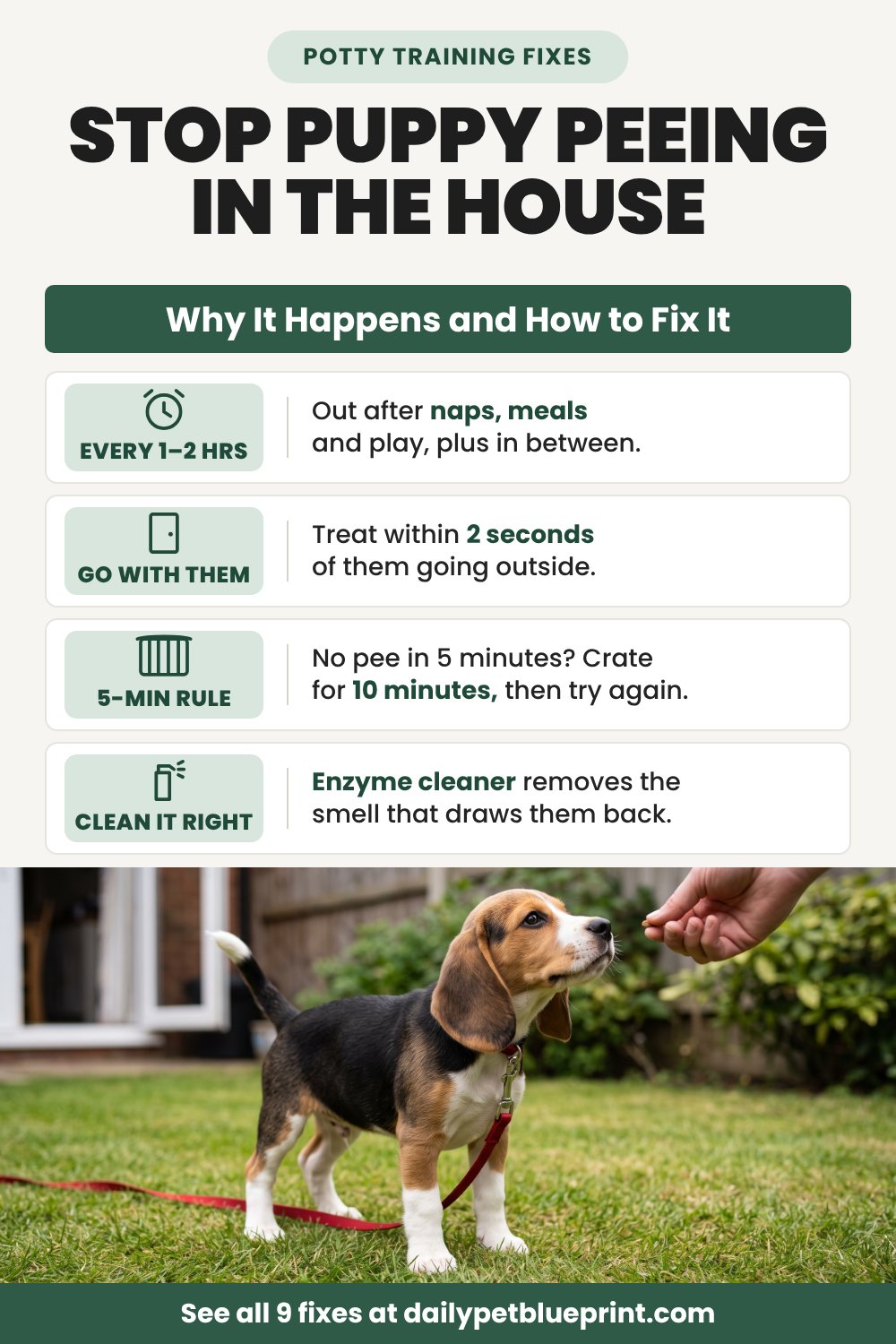
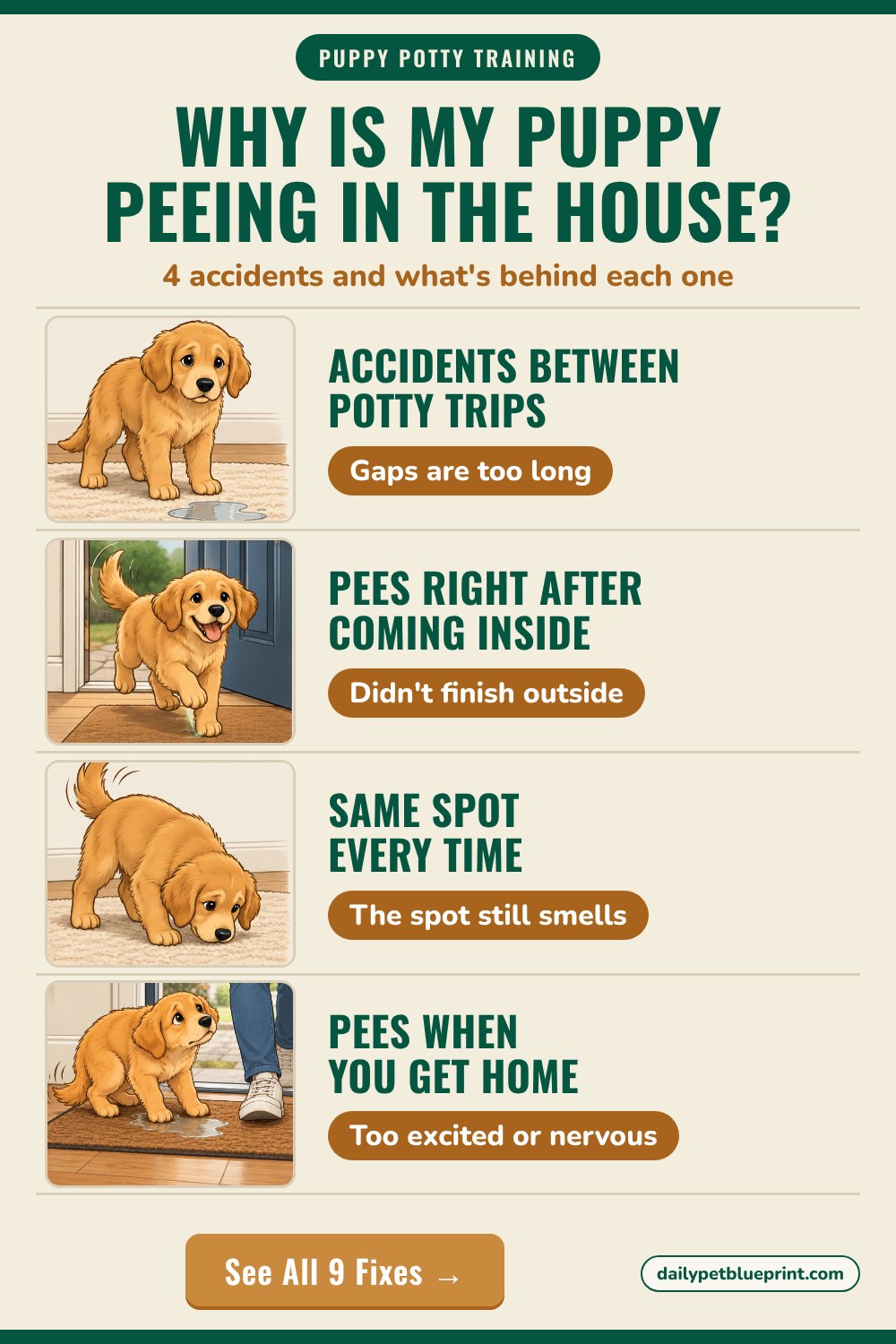
What’s Happening: Accidents between regular trips The Fix: Shorten the interval. Take them out immediately after every nap, meal, and play session, plus every 60 to 90 minutes.
What’s Happening: Pees right after coming back inside The Fix: Use the crate-reset method. If no pee after 5 minutes outside, into the crate for 10 minutes, then straight back out to try again.
What’s Happening: Sneaks away to another room to pee The Fix: Restrict indoor freedom. Use baby gates, an exercise pen, or a lightweight indoor leash tethered to your belt.
What’s Happening: Uses the exact same spot repeatedly The Fix: Soak the area with an enzymatic cleaner to break down the scent enzymes, then place their food bowl or bed over that spot.
What’s Happening: Submissive or excitement urination during greetings The Fix: Keep hellos completely low-key with zero high-pitched talk, eye contact, or sudden bending over; handle greetings outside on the grass.
What’s Happening: Sudden regression or peeing small amounts constantly The Fix: Check with your vet immediately to rule out a urinary tract infection (UTI) or bladder crystals before changing your training.
Why Puppies Pee in the House
Before you change anything, it helps to know what’s actually going on. Most puppies are dealing with one or two of these at once.
Their Bladder Can’t Wait That Long Yet
A young puppy’s bladder is tiny, and the muscles that hold it are still developing. An 8-week-old puppy who’s awake and playing may need to go every 30 to 60 minutes. If the gaps between trips are longer than that, accidents are guaranteed, however good your routine is otherwise.
They Haven’t Linked “Outside” With “Toilet” Yet
Your puppy doesn’t arrive knowing that inside is wrong. They learn it from going outside, again and again, and being rewarded for it. Every accident indoors that goes unnoticed is a little practice at the wrong habit.
Too Much of the House, Too Soon
Puppies don’t like to pee where they sleep or eat. A spare bedroom or a quiet corner behind the sofa, though, feels like somewhere else entirely. A puppy with the run of the house will find those spots fast.
The Spot Still Smells Like a Toilet
Ordinary cleaners get rid of the smell for us, but your puppy can still smell what’s left. To them, the spot is still marked as a toilet. Ammonia-based cleaners make it worse, because ammonia smells a lot like urine to a dog.
Outside Is Too Interesting
Leaves, birds, the neighbor’s cat. Plenty of puppies get so busy sniffing that they forget why they’re out, then remember the second they’re back on the kitchen floor.
Excitement or Nerves
Some puppies leak a little when they’re very excited, like when you come home, or when they feel unsure, like when a stranger leans over them. This is a reflex they can’t control yet, and most grow out of it.
A Medical Problem
Urine infections are common in puppies. If your puppy is suddenly peeing much more often, straining, peeing tiny amounts, or there’s blood or a strong smell, see your vet before you change anything else.
Free · Interactive 7-day plan
Get the free First Week Puppy Plan
A day-by-day plan for your puppy’s first seven days at home: the first night, the crate routine and potty breaks. Tick off each day as you go, and get a short email with tips for the tricky bits.
How to Stop Your Puppy Peeing in the House: 9 Fixes
1. Take Them Out at the Times They Need to Go
Puppies need to pee at predictable moments. Take your puppy out:
- The moment they wake up, from a nap or in the morning
- Within 15 minutes of eating or a big drink
- During and after play, especially if they suddenly stop and wander off
- After any excitement, like visitors arriving
- Last thing before bed
- And every 1 to 2 hours in between for young puppies
If you’re still getting accidents, the gaps are too long. Shorten them for a week, then stretch them slowly. Our Puppy Potty Training Schedule by Age shows how often to go out at each age, with a free printable.
2. Shrink Their World
Until your puppy has gone a few weeks without an accident, they shouldn’t be wandering the house unsupervised. At any moment, your puppy should be in one of three places:
- With you, watched. In the same room, with doors shut or baby gates up. If you’re busy, clip a lead on them and attach it to your belt or a heavy piece of furniture next to you.
- In a pen on an easy-clean floor, with a bed, water and chews.
- In the crate for naps and nights.
Then open up the house one room at a time as they get reliable. Most of the progress in potty training comes from fewer chances to get it wrong.
3. Go Out With Them, Every Time
Opening the back door and letting your puppy out on their own doesn’t teach them much. You don’t know if they went, and you can’t reward them if they did.
Go out with them on a lead, to the same spot each time. Stand still and stay quiet. When they start to go, say your cue word once, like “be quick”, and the moment they finish, praise them and give a treat right there. Within two seconds is ideal. A treat back in the kitchen rewards walking in the door, not peeing outside.
4. Don’t Come In Until They’ve Been
This fixes the classic “pees the second they’re back inside” problem.
- Give them 5 minutes in the potty spot. Keep it boring: no games, no walking around the garden.
- If nothing happens, bring them in and put them straight in the crate or pen for 10 to 15 minutes.
- Take them back out to the same spot and try again.
- Repeat until they go. Then praise, treat, and they’ve earned some free time indoors with you.
5. Learn the Signs They’re About to Go
Most puppies give you a few seconds of warning. Watch for:
- Sniffing the floor with their nose down
- Circling or turning on the spot
- Suddenly stopping play and walking off
- Heading for a corner or a spot they’ve used before
- Whining, or going to the door
The moment you see one, scoop them up and go straight out. Once they’re older, you can teach them to ring a bell at the door to tell you. Our guide to potty training with bells shows how.
6. Interrupt Calmly, Never Punish
If you catch your puppy mid-pee, make a short, neutral sound like “oops”, pick them up and carry them outside to finish. Praise them if they finish out there.
If you find an accident after the fact, just clean it up. Telling them off, and especially rubbing their nose in it, doesn’t teach them where to go. It teaches them that peeing in front of you is dangerous. That’s how puppies end up sneaking behind the sofa and refusing to go on the lead outside.
7. Clean Every Accident With an Enzyme Cleaner
Enzyme cleaners break down the parts of urine that leave a smell behind, so your puppy can’t smell the spot afterwards. Normal sprays only cover it up.
- Blot up as much as you can with kitchen roll. Don’t rub, which pushes it deeper into carpets.
- Soak the area with enzyme cleaner, enough to reach as far as the pee did.
- Leave it for the time on the label, usually 10 to 15 minutes, then blot it dry.
Avoid bleach and anything with ammonia in it.
8. Time Food and Water
Puppies who eat at set times go to the toilet at predictable times. Puppies who graze all day go whenever.
- Feed 3 or 4 meals a day at the same times, and pick the bowl up after 15 minutes.
- Keep water available through the day. Don’t restrict it, as puppies need it.
- Lift the water bowl about 2 hours before bed, unless it’s hot or your vet says otherwise.
9. Keep a Simple Potty Log for a Week
Write down when your puppy eats, sleeps, pees and poos, and when any accidents happen. After three or four days, you’ll usually see a pattern, like an accident about 40 minutes after every lunch. Add a trip just before that time and the accidents stop.
It also stops everyone in the house asking “has he been out?” Our Puppy Potty Training Routine has a full day laid out hour by hour if you want something to follow.
When Your Puppy Pees When Excited or Greeting People
Excitement peeing and nervous peeing aren’t potty training problems, so the usual fixes don’t help. What does help:
- Keep greetings calm. When you come home, ignore your puppy for a minute or two until they’ve settled, then say hello quietly.
- Greet outside or on an easy-clean floor for a few weeks.
- Ask visitors not to lean over your puppy. Crouching down side-on, without staring, feels much less worrying.
- Never tell them off for it. It makes nervous peeing worse.
Most puppies grow out of this by about a year old as their bladder control and confidence improve.
When They Keep Using the Same Spot
If your puppy keeps going back to one rug or one corner:
- Clean it again with enzyme cleaner. Rugs and carpets often need two or three goes.
- Roll the rug up or block the spot with furniture or a gate for a few weeks.
- Once it’s clean, feed a meal or put their bed on that spot. Dogs don’t like to pee where they eat and sleep.
How Long Until Your Puppy Stops Peeing in the House?
With a steady routine, most puppies are reliable by 4 to 6 months old. Small breeds often take longer, sometimes up to a year, because their bladders are smaller.
Expect good days and bad days along the way. A week of accidents after a good spell is normal, especially after a change like a house move, a new person in the house, or a growth spurt. If accidents come back after your puppy has been reliable for a while, see Potty Training Regression.
Mistakes That Make It Worse
Punishing accidents. It teaches your puppy to hide when they pee, which makes outdoor training much harder.
Putting them out alone. You won’t know if they went, and you miss the chance to reward it.
Giving freedom after one good day. Wait for a few weeks of no accidents before opening up more of the house.
Pads by the back door “just in case”. Pee pads indoors tell your puppy that going inside is fine. If you need them, for a high-rise flat or a very young puppy, keep them in one place and plan to phase them out.
Playing outside before they’ve been. Business first, then the fun. Otherwise outside becomes playtime and the pee happens indoors afterwards.
When to See Your Vet
Book a vet check if your puppy:
- Suddenly needs to pee far more often than usual
- Strains, cries or only manages a few drops
- Has blood in their urine, or it smells unusually strong
- Is drinking a lot more than normal
- Leaks urine while asleep or lying down
A quick urine test can rule out an infection, and no amount of training will fix a puppy who physically can’t hold on.
Frequently Asked Questions
Why does my puppy pee right after coming inside?
Usually because they were too busy sniffing or playing to go while they were out. Keep potty trips short and boring, and if they don’t go within 5 minutes, crate them for 10 minutes and try again.
Should I rub my puppy’s nose in it?
No. Your puppy can’t connect it with the pee, and it makes them scared to pee in front of you, which slows down potty training.
How often should I take my puppy out to pee?
For an 8 to 10 week old puppy, every 30 to 60 minutes while they’re awake and active, plus after naps, meals and play. The gaps get longer as they grow.
My puppy is peeing in the house all of a sudden. Why?
Sudden changes are worth a vet check first, since urine infections are common in puppies. If your puppy is healthy, look for a change in routine, more freedom than they’re ready for, or an old spot that wasn’t cleaned with an enzyme cleaner.
Do puppy pads help or make it worse?
They can help if you live in a flat with no quick way outside. Otherwise they usually slow things down, because they teach your puppy that going indoors is allowed.
The Bottom Line
Most puppies who pee in the house just need more trips out, less freedom indoors for a while, a treat the second they go outside, and every accident cleaned with an enzyme cleaner. Stick with it for a couple of weeks and you’ll see the accidents drop off.
And if your puppy was doing well and the accidents have started again, the next guide explains why and what to do: Potty Training Regression: Why It Happens and What to Do.
Your New Puppy Journey
Puppy Potty Training & Crate Training
Crate training first, then potty training, in the order you’ll need them.
Start hereChoose the right crate →See all steps
Crate Training
- What Size Crate for a Puppy?
- First Night With a New Puppy
- Why Does My Puppy Cry at Night?
- How to Crate Train a Puppy: The 5-Day Method
- Puppy Crate Training Tips
- What to Do When Your Puppy Cries or Whines in the Crate
- When to Stop Crate Training
Potty Training
- Puppy Potty Training Routine
- Puppy Potty Training Schedule by Age
- Puppy Feeding Schedule by Age
- Potty Training a Puppy With Bells
- Potty Training an Apartment Dog
- How to Stop Your Puppy Peeing in the House
- Potty Training Regression
More for New Puppy Owners
Free · Interactive 7-day plan
Get the free First Week Puppy Plan
A day-by-day plan for your puppy's first seven days at home: the first night, the crate routine and potty breaks. Tick off each day as you go, and get a short email with tips for the tricky bits.