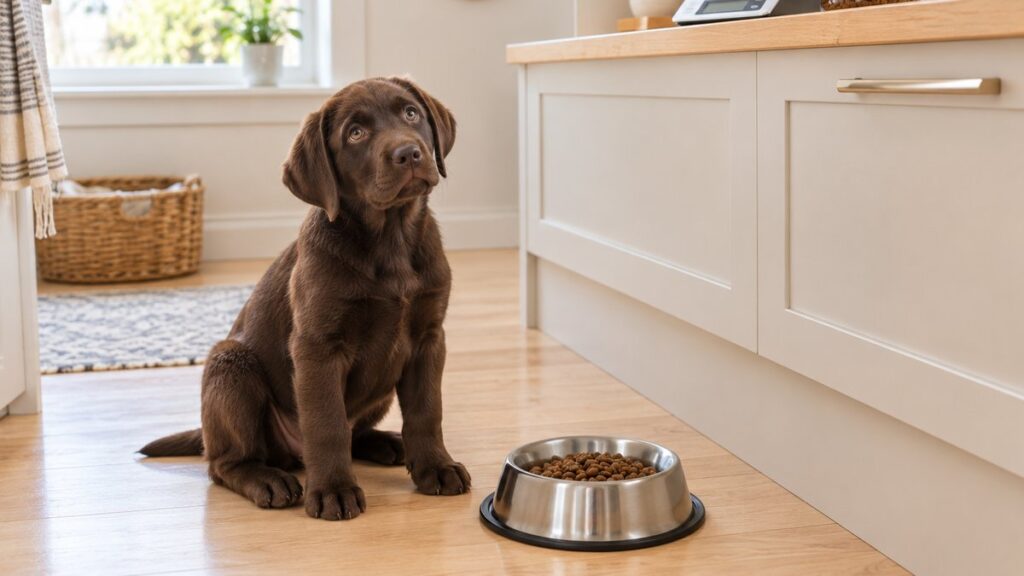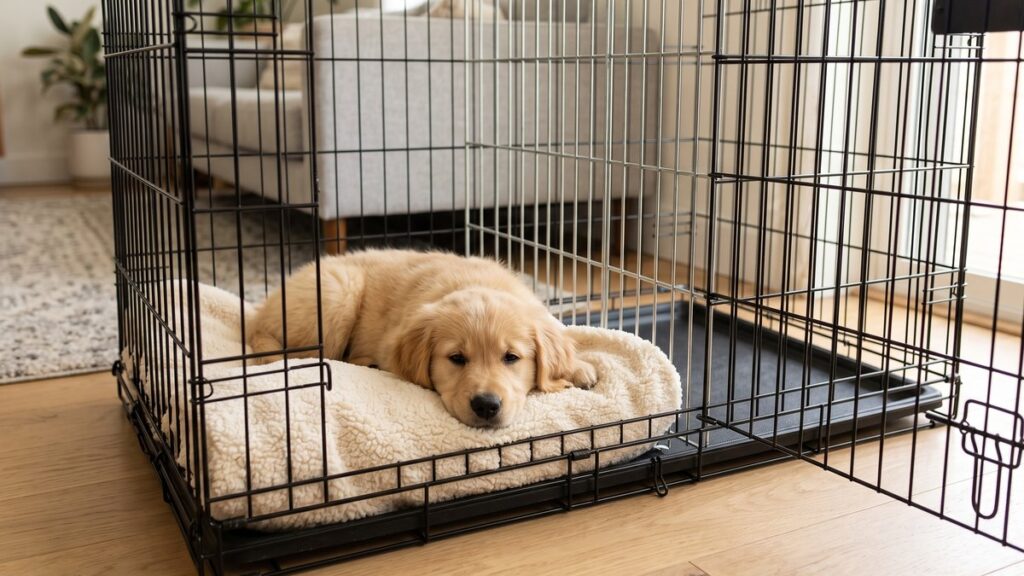
The puppy coming home this week might fit inside a shoebox, but the dog they become in a year could weigh 70 pounds.
The crate you buy today has to safely work for both.
Get the size wrong in one direction, and your puppy uses one corner as a bed and the other as a bathroom, derailing potty training before it starts.
Get it wrong in the other direction, and they outgrow it in weeks, forcing you to buy a second expensive crate by month four.
The golden rule is counterintuitive: always buy for your puppy’s estimated adult size, but use an adjustable divider panel to limit their usable space right now.
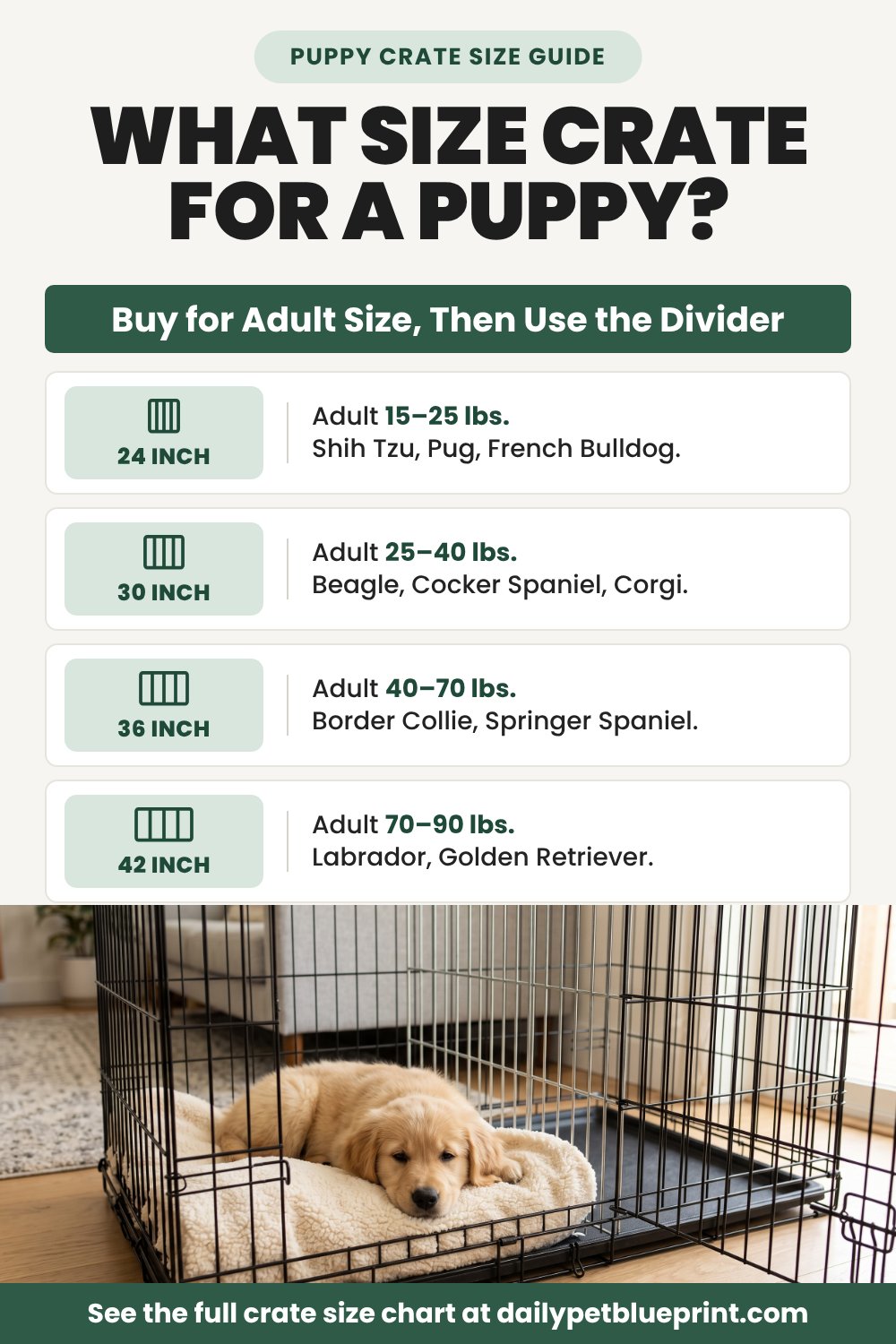
Use this quick adult weight guide to determine the correct crate dimensions:
Expected Adult Weight: Up to 15 lbs | Crate: 18 to 22 inch | Breeds: Chihuahua, Yorkshire Terrier, Maltese, Toy Poodle
Expected Adult Weight: 15 to 25 lbs | Crate: 24 inch | Breeds: Shih Tzu, Pug, French Bulldog, Cavalier King Charles Spaniel
Expected Adult Weight: 25 to 40 lbs | Crate: 30 inch | Breeds: Beagle, Cocker Spaniel, Corgi, Staffordshire Bull Terrier
Expected Adult Weight: 40 to 70 lbs | Crate: 36 inch | Breeds: Border Collie, Springer Spaniel, Australian Shepherd, Bulldog
Expected Adult Weight: 70 to 90 lbs | Crate: 42 inch | Breeds: Labrador, Golden Retriever, German Shepherd, Boxer
Expected Adult Weight: Over 90 lbs | Crate: 48 inch or larger | Breeds: Bernese Mountain Dog, Rottweiler, Newfoundland, Great Dane (54 inch)
Not sure which band your puppy falls into? That’s the part most owners get stuck on, so it’s where we’ll start.
Step 1: Work Out How Big Your Puppy Will Get
You don’t need an exact number. You need to know which crate size band they’ll end up in. How you get there depends on what you know about your puppy.
If Your Puppy Is a Pedigree
This is the easy one. Look up the breed’s typical adult weight and go from there. Males usually end up at the top of the range and females lower down, so if you have a male from a large breed, plan for the upper end.
Your breeder is a good source too. Ask how big the mother and father are. Puppies usually land somewhere close to their parents.
If Your Puppy Is a Mixed Breed or Rescue
Harder, but not guesswork. Use as many of these as you can:
- The parents. If you know either parent’s size, that’s your best clue. Plan for the bigger one.
- Your puppy’s current weight and age. Our Puppy Weight Calculator gives you an estimated adult weight in seconds.
- Your vet. At the first check, ask what size they think your puppy will be. They see a lot of puppies and can usually narrow it down.
- The rescue’s estimate. Rescues often have a good idea from the litter and any known parents. Treat it as a range, not a promise.
Don’t Go by Paw Size
Big paws are a popular rule of thumb, but they’re not a reliable one. Some puppies have big feet and stay medium-sized, and some breeds just have neat feet whatever their size. Use the parents and their weight at a known age instead.
Remember Big Dogs Grow for Longer
Small breeds are usually close to their adult size by 9 to 12 months. Medium breeds take 12 to 15 months, large breeds 15 to 18 months, and giant breeds can keep filling out until 2 years. A large-breed puppy who looks done at 7 months often isn’t.
Free · Interactive 7-day plan
Get the free First Week Puppy Plan
A day-by-day plan for your puppy’s first seven days at home: the first night, the crate routine and potty breaks. Tick off each day as you go, and get a short email with tips for the tricky bits.
Step 2: Buy the Crate for Their Adult Size
Once you have an estimated adult weight, use the guide at the top of this page to pick a crate length. A wire crate with a divider panel is the best choice for a growing puppy, because one crate can last from 8 weeks to adulthood.
Check that the divider is included before you buy. Most wire crates come with one, but not all. Plastic crates usually don’t have dividers at all, which is why they’re better as a second crate for travel than as your main crate for a growing puppy.
If your puppy sits right on the line between two sizes, go for the bigger one. You can always make a big crate smaller with the divider. You can’t make a small crate bigger.
For the pros and cons of wire, plastic, soft-sided and furniture-style crates, see Choosing the Right Size and Type of Crate.
Step 3: Set the Divider for Your Puppy Now
This is the step that makes the whole thing work. The divider turns an adult-sized crate into a snug puppy den.
How to measure your puppy:
- Length: while they’re standing, measure from the tip of their nose to the base of their tail (not the tip). Add 2 to 4 inches.
- Height: while they’re sitting, measure from the floor to the top of their head, or ear tips if their ears stand up. Add 2 to 4 inches.
Set the divider so the space inside is about their length plus those few inches. A squirming 8-week-old won’t stand still for a tape measure, so do it while they’re eating or ask someone to help.
The quick check: your puppy should be able to stand up without ducking, turn around easily and lie down stretched out on their side. If there’s enough room left over for them to walk a few steps away from their bed, the space is too big.
When You Really Can’t Tell How Big They’ll Get
Some puppies just don’t give you much to go on. If your best estimate is a wide range, you have two sensible options.
Option 1: Buy for the top of the range and use the divider. If your rescue puppy could end up anywhere from 40 to 80 lbs, get a 42 inch crate with a divider. It costs a little more now, but you only buy once.
Option 2: Buy a cheap crate now and upgrade later. Get an inexpensive or secondhand crate that fits them for the first few months, then buy the right adult crate once their size is clearer, usually around 5 to 6 months. This makes sense if money is tight right now or space in your home is limited.
Doodles and Other Designer Mixes
Doodles are some of the hardest puppies to size. A “mini” Goldendoodle can end up anywhere from about 15 to 35 lbs, and a standard can be 50 to 90 lbs, depending on the poodle parent and the generation.
Ask your breeder for both parents’ weights and what earlier litters from the same pairing grew to. If they can’t tell you, size for the bigger parent and use the divider.
Check the Fit as They Grow
Puppies can grow surprisingly fast, especially large breeds between 3 and 6 months. Check the fit every couple of weeks and move the divider back a little at a time.
Signs the space is now too small:
- Their head touches the top when they sit up
- They can’t lie stretched out on their side
- They always sleep curled tightly, even on warm nights
- They struggle to turn around or bump the sides when they do
Signs the space is too big:
- Accidents in the crate, usually at the far end from their bed
- They sleep at the front and treat the back as a separate room
If you see accidents after moving the divider back, move it forward again for another week or two. Your puppy’s bladder control may not have caught up with their size yet.
Common Crate Size Mistakes
Buying a “puppy-sized” crate for a large breed. It fits perfectly at 8 weeks and not at all by 14 weeks. Big breeds need the big crate from the start, with the divider doing the work.
Giving them the whole crate straight away. An adult-sized crate without a divider is the most common reason puppies have accidents in the crate.
Forgetting to move the divider. It’s easy to set it once and forget it. A puppy who’s outgrown their space will start to resist going in.
Going by the label alone. Crate sizes vary between brands. Check the inside measurements against your puppy’s estimated adult size, not just the length on the box.
Frequently Asked Questions
Should I buy a puppy-sized crate or an adult-sized crate?
For most puppies, an adult-sized wire crate with a divider is the best value, because it lasts from day one to adulthood. The exception is toy breeds, where the puppy and adult crates are so close in size it barely matters.
Can a crate be too big for a puppy?
Yes. A crate that’s too big gives your puppy room to pee at one end and sleep at the other, which slows down house training. That’s what the divider is for.
What size crate does a Labrador puppy need?
Most Labradors need a 42 inch crate as adults. Buy that size with a divider and section it down to suit your puppy now.
What if my puppy outgrows the crate before they’re fully grown?
Move up a size. It happens most with mixed breeds who end up bigger than expected. A secondhand crate or one passed on from a friend keeps the cost down.
Does a bigger crate make my puppy more comfortable?
Not really. Puppies feel safest in a snug, den-like space. Enough room to stand, turn and stretch out is all they need.
The Bottom Line
Estimate your puppy’s adult size, buy a wire crate for that size, and use the divider to keep their space snug while they grow. Check the fit every couple of weeks, and one crate can see your puppy all the way from their first night to adulthood.
Once the crate is set up, the next step is planning your puppy’s first night in it: First Night With a New Puppy: Crate Setup and Bedtime Plan.
Your New Puppy Journey
Puppy Potty Training & Crate Training
Crate training first, then potty training, in the order you’ll need them.
Start hereChoose the right crate →See all steps
Crate Training
- What Size Crate for a Puppy?
- First Night With a New Puppy
- Why Does My Puppy Cry at Night?
- How to Crate Train a Puppy: The 5-Day Method
- Puppy Crate Training Tips
- What to Do When Your Puppy Cries or Whines in the Crate
- When to Stop Crate Training
Potty Training
- Puppy Potty Training Routine
- Puppy Potty Training Schedule by Age
- Puppy Feeding Schedule by Age
- Potty Training a Puppy With Bells
- Potty Training an Apartment Dog
- How to Stop Your Puppy Peeing in the House
- Potty Training Regression
More for New Puppy Owners
Free · Interactive 7-day plan
Get the free First Week Puppy Plan
A day-by-day plan for your puppy's first seven days at home: the first night, the crate routine and potty breaks. Tick off each day as you go, and get a short email with tips for the tricky bits.