“Colorful” grooming covers a different look than a rainbow gradient: distinct blocks and accents of color rather than one shade smoothly blending into the next. For the full picture on creative grooming, see Creative Dog Grooming: Dye and Styling Trends.
Blocks and Accents, Not a Blend
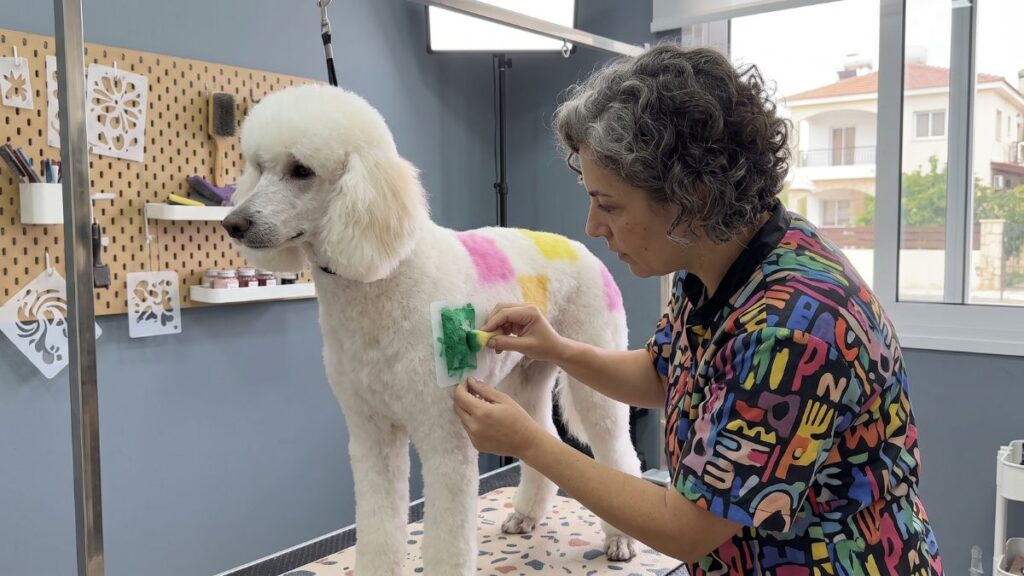
Where a rainbow design relies on smooth color transitions, a colorful design often uses distinct sections, geometric blocks, or scattered accents, each color staying separate and clean-edged rather than flowing into its neighbor.
A geometric mosaic pattern, angular blocks of pink, green, blue, yellow, and orange, is one common version, creating a modern, structured look against the dog’s natural or clipped-white coat.
Multi-Color Accent Placement
Rather than covering the whole body, many colorful designs focus color on specific features: ears in one shade, paws in another, a tail tip in a third, giving variety without full-body commitment.
This approach also makes touch-ups more manageable, since each accent area can be refreshed or changed independently rather than needing a full-coat redo.
Choosing a Palette
Complementary pastels (pink, lavender, mint, pale yellow) create a soft, cohesive look that reads as coordinated rather than random.
Bold, saturated primary and secondary colors create a bigger visual impact but need more careful planning to avoid looking cluttered rather than intentional.
Coat Type and Placement
Curly and dense coats hold distinct color blocks more reliably than straight coats, since the texture itself helps keep each section visually separate rather than blending at the edges as the coat grows.
A white or very light base coat gives every color maximum vibrancy and clean contrast between sections, which matters more for a blocky, structured design than a blended one.
Safety Notes
Every color used still needs to be a pet-specific, tested product, applied away from the eyes, ears, and genital area, with a patch test done before full application. More colors in one design just means more products to verify are genuinely pet-safe, not a different safety standard.
Common Mistakes
Using too many colors without a clear plan. A design with no clear structure can end up looking chaotic rather than intentional.
Mixing product types without checking compatibility. Some dyes and chalks don’t layer well together, leading to muddy or uneven color.
Assuming a straight coat holds blocky patterns as well as a curly one. Distinct color edges blur faster on a straighter coat as it grows out.
FAQ
How is “colorful” grooming different from a rainbow design?
Rainbow designs blend colors smoothly into each other. Colorful designs typically keep colors in distinct blocks, sections, or accents.
Do I need a professional for a multi-color design?
Simple accent placements are reasonable for a confident beginner, but a structured geometric pattern benefits from professional stencil work and experience.
How many colors is too many?
There’s no fixed limit, but a clear plan, sketched out before applying dye, keeps a multi-color design looking intentional rather than random.
The Bottom Line
Colorful grooming is about distinct, well-placed color sections rather than a single blended gradient, and it rewards planning the layout before any dye goes on. For more creative grooming ideas, head back to Creative Dog Grooming: Dye and Styling Trends.