A reactive dog isn’t a bad dog or a badly trained dog. Reactivity is an emotional response, usually fear or frustration, that shows up as barking, lunging, growling, or freezing when your dog spots a trigger, most often another dog, a stranger, or a bike.
Training a reactive dog means changing how they feel about that trigger, not just stopping the behaviour on the surface.
The good news is that reactivity is one of the most treatable behaviour issues in dogs, provided you work at the right distance, in the right order, and with real consistency. Here’s what actually moves the needle.
What “Reactive” Actually Means
Reactive dogs aren’t aggressive dogs, though the two get confused constantly. An aggressive dog wants to make contact and cause harm. A reactive dog wants the scary or exciting thing to go away, and barking, lunging, and pulling are how they try to make that happen.
Reactivity usually falls into one of three roots: fear (the trigger feels threatening), frustration (the dog wants to greet or chase but is stopped by a leash), or over-arousal (the dog is so excited the nervous system tips into a meltdown).
Knowing which one you’re dealing with changes your approach, so watch your dog’s body language closely during the first few sessions. A fearful dog leans back, tucks their tail, and tries to create distance. A frustrated greeter pulls forward, whines, and wags stiffly while barking.
Find Your Dog’s Threshold Distance First
Before any training technique works, you need to know your dog’s threshold distance: the point at which they notice a trigger but can still take treats, respond to their name, and think clearly. Push past that point and your dog is “over threshold,” which means their brain has switched from learning mode into pure reaction mode. No training happens over threshold, no matter how good your treats are.
Finding this distance takes a bit of trial and error. Take your dog somewhere you can control the environment, a quiet car park or the edge of a large field works well, and have a trigger appear at a distance you’re confident is too far to cause a reaction.
Watch closely as the trigger gets slightly closer over several sessions: the first sign of a hard stare, a closed mouth, or stiff shoulders means you’ve found the edge of their comfort zone, and that’s where your training sessions should start.
Most owners start too close because it feels like it should be working faster. It doesn’t. Every session where your dog reacts is a rehearsal of the reaction, and rehearsed behaviour gets stronger, not weaker.
The Core Method: Counter-Conditioning and Desensitization
The two techniques that actually change a reactive dog’s underlying emotional response are counter-conditioning and desensitization, and they work best together.
Desensitization means gradually reducing your dog’s sensitivity to a trigger by exposing them to it at a low enough intensity that they stay calm, then slowly closing the distance over many sessions. Counter-conditioning means pairing the trigger with something your dog loves, usually high-value food, so the trigger itself starts to predict good things rather than danger.
How a session actually works
Here’s what this looks like in practice, step by step:
- Get your dog to a spot where a trigger will appear at or beyond their threshold distance.
- The second your dog notices the trigger, start feeding small, high-value treats (think chicken, cheese, or hot dog, not their regular kibble) one after another, steadily, not as a reward for a specific behaviour.
- Keep feeding for as long as the trigger is visible. When it’s gone, stop feeding.
- Repeat this over multiple sessions and multiple triggers, gradually decreasing the starting distance by small amounts only once your dog is consistently relaxed at the current distance.
The order matters. Trigger appears, then food starts. If the food comes first, you’re not building an association between the trigger and good things, you’re just distracting your dog, and the fear or frustration underneath never actually changes.
Done correctly and consistently, most dogs start to associate the sight of a trigger with “treats are coming” within a few weeks, which is the moment you’ll see them glance at you instead of locking onto the trigger.
Trainers call this the conditioned emotional response, and it’s the real goal of the whole process.
The “Look At That” Game
Once your dog has some counter-conditioning under their belt, the engage-disengage game, often called Look At That or LAT, builds on it by rewarding your dog for choosing to look away from the trigger on their own.
The mechanics are simple. The moment your dog looks at the trigger, mark it with a word like “yes” or a clicker, then reward the instant they look back at you. You’re not asking for eye contact, you’re rewarding the natural head-turn that happens after a brief look. Over time, dogs start offering that look-back voluntarily, almost like a habit, because glancing at the trigger has become the cue that predicts a reward from you.
This game is particularly useful on walks because it gives your dog a job to do around triggers instead of just white-knuckling through the encounter. It also builds the pattern of checking in with you, which becomes genuinely useful once you’re managing real-world triggers that show up without warning.
Reading the Early Warning Signs
Most reactions have a build-up phase, and catching it early gives you a chance to add distance or redirect before your dog goes over threshold. A closed mouth after relaxed panting, a sudden freeze mid-stride, ears pinning forward, or the tail rising and stiffening are all early signals, and they usually show up several seconds before the bark or lunge.
Learning your own dog’s specific pattern matters more than memorising a generic list, because the order these signs appear in varies from dog to dog. Some dogs go straight from relaxed to barking with barely a pause.
Others telegraph clearly for five or six seconds first. Watching your dog on walks without a phone in hand, specifically looking for these small shifts, is genuinely one of the highest-value things you can do early in training.
Common Triggers and Why They’re Not All the Same
Reactivity toward other dogs, strangers, and moving objects like bikes or cars often gets lumped together, but the underlying drivers can be quite different, and that changes how you’ll want to work through each one.
Dog-to-dog reactivity is frequently a mix of frustration and fear, particularly in dogs who were highly social as puppies and then had a bad experience, or dogs who never got enough structured exposure during their early socialisation window. Reactivity toward strangers tends to sit closer to pure fear, especially in dogs adopted as adults with an unknown history.
Reactivity toward bikes, joggers, skateboards, and cars is usually rooted in movement-triggered prey drive or predatory chase instinct rather than fear at all, which is why food alone sometimes works more slowly here than it does for fear-based triggers, and adding movement-based rewards, like tossing a treat away from the trigger to trigger a chase of the treat instead, can help.
Treating all three the same way is one of the quieter reasons training plateaus. If progress with one trigger type has stalled, it’s worth reconsidering which category it actually falls into.
Management Tools That Make Training Possible
Training takes weeks or months. In the meantime, you still need to walk your dog, and every unmanaged reaction sets progress back. These tools aren’t cheating, they’re what keeps your dog under threshold while the real work happens in the background.
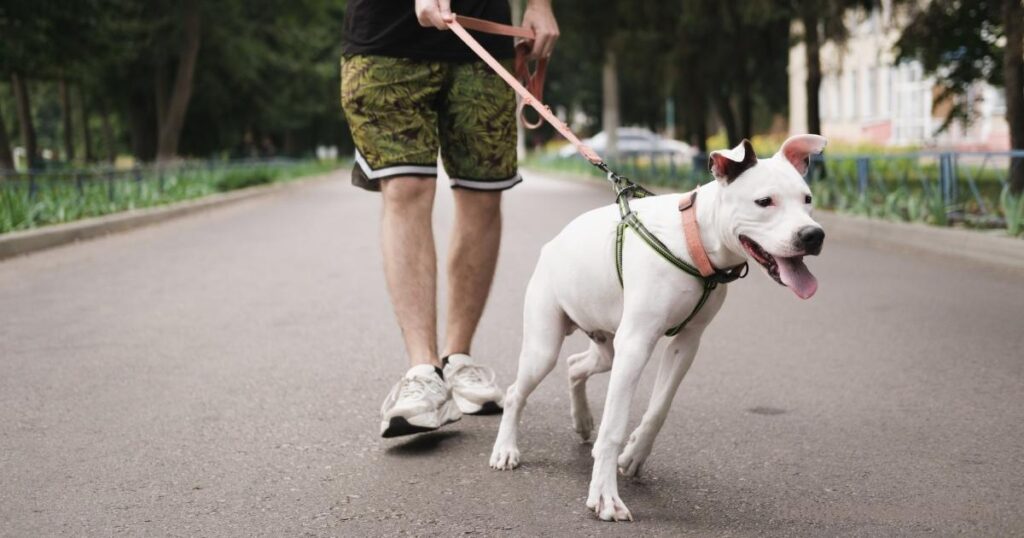
A front-clip harness gives you more control over a lunging dog’s direction without the pressure landing on their throat, which matters because throat pressure can actually increase arousal and frustration in some dogs. A long line in open spaces lets your dog have more freedom to move and sniff, which lowers overall stress, while still keeping you in control if a trigger appears unexpectedly. Visual barriers, like parking your car between your dog and an approaching trigger, or simply crossing the street early, buy you distance in situations you can’t fully plan for.
Route planning matters more than most owners expect. Walking at quieter times, choosing wider paths, and having an exit plan for tight spots like narrow pavements or blind corners will prevent far more reactions than any single training technique.
Common Mistakes That Keep Dogs Reactive
Punishing the reaction. Yelling, leash-popping, or using a spray bottle when your dog barks or lunges can suppress the outward behaviour, but it does nothing for the underlying fear or frustration, and it often teaches the dog that the trigger predicts something unpleasant from you too. That tends to make the next reaction worse, not better.
Flooding. This means exposing a dog to a trigger at close range and just waiting for them to “get used to it.” Some dogs shut down and look calm, which owners mistake for progress, when what’s actually happened is called learned helplessness, not comfort. Others simply escalate.
Inconsistent distance. Working at threshold on Monday and then walking straight past a trigger at three feet on Tuesday because you’re in a rush undoes real progress. Reactivity training needs the environment managed every single time, not just during formal sessions.
Skipping the “cool down” period after a reaction. If a reaction does happen, and it will occasionally, your dog’s stress hormones stay elevated for a while afterwards, sometimes over an hour. Trying to train again too soon means starting from a higher baseline of stress than usual, which makes the next session harder than it needs to be.
How Long Does This Actually Take?
There’s no fixed timeline, because it depends on the dog’s history, genetics, and how consistently you work at the correct distance. Mild reactivity in a young dog can improve noticeably within four to six weeks of consistent counter-conditioning. A dog with a longer history of practising the behaviour, or a strong genetic predisposition toward fear or arousal, may take several months to show a real shift, and ongoing management may always be part of the picture even once things improve significantly.
Progress in reactivity training rarely looks like a straight line. Expect good weeks and rough weeks, and judge progress over a month rather than session by session.
When to Call In a Professional
Reactivity that involves any bite history, a dog who can’t be safely walked at all, or a reaction that seems to be escalating despite consistent management is worth bringing in outside help for. A certified professional dog trainer with real experience in reactivity, or a veterinary behaviourist for more severe cases, can assess your specific dog and rule out pain or a medical cause, which is worth checking since chronic pain is a surprisingly common hidden driver of new-onset reactivity in adult and senior dogs.
Frequently Asked Questions
Can a reactive dog be fully cured? Many dogs improve enough that reactivity stops affecting daily life, but “cured” isn’t always the right framing. Some dogs will always need a bit more distance and management around specific triggers, similar to how a person with a phobia might manage rather than completely eliminate it.
Is reactivity the same as aggression? No. Reactivity is an over-the-top response to a trigger, usually driven by fear, frustration, or excitement. True aggression, where a dog intends to make contact and cause harm, is far less common and needs a different, more careful approach.
Should I avoid triggers completely while training? Not entirely, but you should control the distance and intensity of exposure. Complete avoidance can work short-term for a very stressed dog that needs a break, but long-term progress needs some structured exposure at a distance the dog can handle.
What breeds are more prone to reactivity? Reactivity isn’t breed-specific in the way people assume. Herding breeds and some guarding breeds are statistically overrepresented, largely due to genetic sensitivity to movement and strangers, but any breed or mixed breed can become reactive depending on genetics, socialisation history, and individual temperament.
The Bottom Line
Reactive dog training works when you stop trying to stop the barking and start changing how your dog feels about what’s in front of them. Find the threshold distance, pair triggers with something your dog genuinely loves, manage the environment while the real work happens, and give it time. Most reactive dogs aren’t broken, they’re stuck in a pattern that hasn’t had the right training applied to it yet.