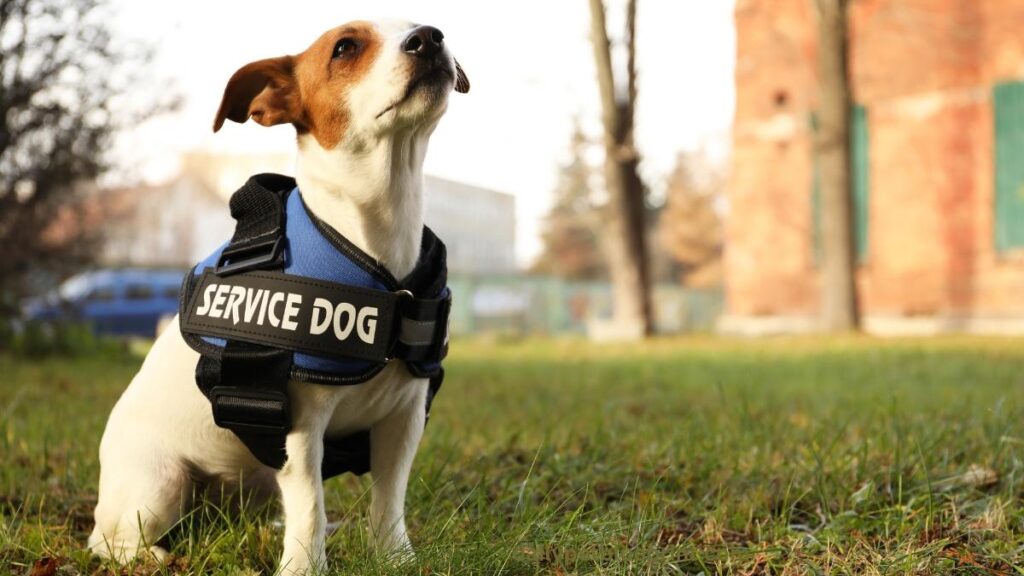
If you’re researching psychiatric service dogs, you’re probably trying to understand exactly what they do, whether one could genuinely help, and what the process actually involves.
This guide covers what a psychiatric service dog is, the kinds of tasks they’re trained to perform, the legal rights that come with one, and why the actual task training needs to happen with a qualified professional rather than from general advice online.
For the foundation every service dog needs first, see our complete guide: Service Dog Training: A Complete Beginner’s Guide.
What a Psychiatric Service Dog Actually Is
A psychiatric service dog (PSD) is a dog individually trained to perform specific tasks that help a person manage a diagnosed mental health condition.
Under the Americans with Disabilities Act (ADA), a service dog is legally defined by what it’s trained to do, not by the condition it helps with.
That means a psychiatric service dog has the same legal status and public access rights as a guide dog or a mobility assistance dog.
The key requirement is that the dog performs a specific, trained task directly related to the handler’s disability, not just general comfort or companionship.
Psychiatric Service Dog vs Emotional Support Animal vs Therapy Dog
These three terms get mixed up constantly, but they mean very different things legally.
An emotional support animal (ESA) provides comfort through its presence, but isn’t trained to perform a specific task, and does not have the same public access rights as a service dog.
A therapy dog is trained to provide comfort to other people, often in hospitals or schools, and also doesn’t have service dog access rights.
A psychiatric service dog is trained to do a specific job for its own handler, and that trained task is what grants it legal service dog status under the ADA.
Understanding this distinction matters, because misrepresenting a pet or ESA as a service dog can create real problems, both legally and for the broader trust that legitimate service dog teams rely on in public spaces.
Common Tasks a Psychiatric Service Dog Might Perform
Task training is always built around the individual handler’s specific needs, working closely with a professional who understands both the condition and sound training methods.
Some commonly recognized categories of psychiatric service dog tasks include:
- Interrupting harmful behaviors by using trained physical contact, like a nudge or paw, to redirect the handler’s attention
- Creating physical space in crowded environments for a handler who experiences anxiety in close quarters
- Retrieving medication or reminding a handler to take it at a scheduled time
- Providing deep pressure therapy, a trained technique where the dog applies calming weight or contact during moments of distress
- Guiding a handler to an exit during a difficult moment in a public space
Every one of these tasks needs to be taught precisely and safely, which is why this always happens under professional guidance rather than through general instructions.
Who Qualifies for a Psychiatric Service Dog
Under the ADA, a person qualifies if they have a diagnosed mental health condition that substantially limits a major life activity, and the dog is trained to perform a task directly related to that condition.
Conditions commonly associated with psychiatric service dogs include PTSD, panic disorder, and severe anxiety disorders, among others.
A diagnosis alone isn’t enough.
The dog also needs genuine, task-specific training, which is what separates a legitimate psychiatric service dog from a pet that simply provides comfort.
Anyone considering this path should start by talking to their treating mental health professional, since they’re best placed to say whether a task-trained dog could meaningfully support a specific treatment plan.
How Psychiatric Service Dogs Are Trained
There are generally two paths: working with a professional service dog training program, or owner-training with guidance from a qualified professional trainer experienced in service dog work specifically.
Reputable programs typically start with a temperament evaluation, since not every dog, regardless of breed, has the right combination of stability, focus, and trainability for this work.
Task training is highly individualized, built around the handler’s specific triggers and needs, which is exactly why it can’t be reduced to a generic step-by-step guide.
Training a dog to recognize and respond to a genuine panic attack or dissociative episode, for example, requires an experienced professional who understands both dog behavior and the handler’s specific condition.
Getting this wrong doesn’t just mean a weaker service dog.
It can mean a handler relying on a response that doesn’t actually work when they need it most.
Legal Rights and Public Access
Under the ADA, a legitimate psychiatric service dog can accompany its handler into most public spaces, including restaurants, stores, and public transportation.
Businesses are only allowed to ask two specific questions: whether the dog is a service animal required because of a disability, and what task the dog is trained to perform.
They cannot ask for documentation, a demonstration, or details about the handler’s diagnosis.
Airlines and housing providers have their own specific rules, which are worth checking directly with the Department of Transportation and Fair Housing guidance if that applies to your situation.
Why This Needs Professional Guidance
Task training for a psychiatric service dog directly affects someone’s ability to manage a real mental health condition in daily life.
An improperly trained task, or a dog that responds inconsistently, can leave a handler without support in exactly the moment they need it.
This is why legitimate task training is always done with, or under the close guidance of, a professional who has genuine experience with psychiatric service dog work specifically, not general obedience training extended into new territory.
Organizations like Assistance Dogs International (ADI) and the International Association of Assistance Dog Partners (IAADP) are a good starting point for finding accredited programs and legitimate guidance.
Frequently Asked Questions
Can any dog become a psychiatric service dog?
Any breed can potentially qualify, but the individual dog needs the right temperament: stable, focused, and capable of reliable task performance under stress. A professional evaluation is the right way to find out.
Do I need a diagnosis to get a psychiatric service dog?
Yes. The ADA requires a diagnosed condition that substantially limits a major life activity, and the dog must be trained to perform a task directly related to it.
Is a psychiatric service dog the same as an emotional support animal?
No. An ESA provides comfort through presence alone and doesn’t have service dog public access rights, while a psychiatric service dog is trained to perform specific tasks and has full ADA service dog status.
How long does it take to train a psychiatric service dog?
Programs vary, but task training commonly takes many months to over a year, since it builds on a foundation of solid obedience before any specialized task work begins.
The Bottom Line
A psychiatric service dog can be a genuinely valuable part of managing a mental health condition, but the training that makes that possible is specialized, individualized work.
If this is something you’re considering, the right first steps are talking with your treating mental health professional and researching accredited programs or qualified professional trainers, not attempting to design task training from general information alone.
A strong foundation of basic obedience is something you can absolutely begin building yourself, and it’s the starting point every legitimate program builds on: Dog Obedience Training: The Complete Guide.