Training doesn’t have to feel like formal practice every time. A handful of genuinely fun games double as real training, reinforcing skills your dog already knows while keeping things playful and something your dog actively looks forward to.
This guide covers games worth adding into your regular routine.
For a related set of purely mental challenges, see: Brain Games to Train Your Dog’s Mind.
Hide and Seek With Recall
Have someone hold your dog while you hide, then call your dog’s name once you’re settled, rewarding enthusiastically the moment they find you.
This is genuinely one of the best games for reinforcing a strong, excited recall, since it turns coming when called into something actively fun rather than just a command.
Find It
Toss a treat and say “find it” as your dog searches it out on the floor, gradually progressing to hiding treats around a room for them to sniff out.
This game builds naturally on scent-seeking instincts and works well as a calm, low-energy option for rainy days or smaller spaces.
The Name Game
Say your dog’s name, and the instant they look at you, mark and reward.
This simple game builds a rock-solid response to their name being called, which underpins nearly every other command and cue you’ll ever teach.
Two Toy Fetch
Using two identical toys, throw the first, and once your dog picks it up, show them the second toy to encourage a faster, more willing return, then throw the second toy the moment they drop the first.
This keeps the game moving and tends to build a more reliable retrieve than waiting for a slow, reluctant drop.
Tug With Rules
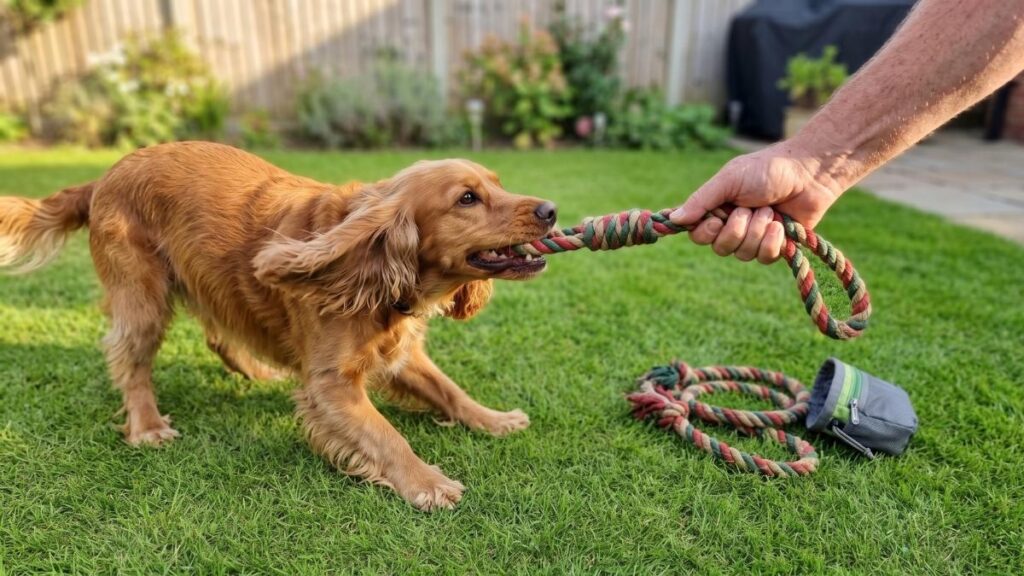
Tug is a genuinely great outlet for a lot of dogs, and teaching clear start and stop cues, like “take it” and “drop it,” turns it into a structured game that reinforces impulse control alongside the fun.
Always initiate and end the game yourself, and pause immediately if teeth ever touch skin, resuming only once your dog is calm again.
Red Light, Green Light
This game asks your dog to move with you on green light and stop and sit on red light, genuinely reinforcing impulse control and attention in a way that feels like play rather than drilling.
Keep the rounds short and upbeat, rewarding good stops generously in the early stages.
The Shell Game as a Group Activity
While the shell game works well solo, it also makes a fun activity to do with kids or other family members taking turns hiding the treat, keeping your dog engaged with multiple people rather than just one.
This is a good option for building a dog’s comfort interacting with different family members during structured, positive activities.
Obstacle Course From Household Items
Everyday items, a broom laid on the floor to step over, a laundry basket to weave around, cushions to hop onto, can become a simple obstacle course that builds body awareness and confidence.
Keep obstacles low and stable, and use treats to lure your dog through each element the first few times.
Which Toy Suits a Rough Chewer
Games involving a lot of grabbing, tugging, or mouthing wear through soft toys quickly with a determined chewer, so a durable rubber or rope toy tends to hold up far better across repeated game sessions than a plush option.
Rotating in a few tougher toys specifically for interactive games, separate from softer comfort toys, saves considerable money over time.
Playing These Games With Multiple Dogs
If you have more than one dog, most of these games work best introduced one dog at a time initially, since competition for a single toy or treat can create tension that undermines the fun, relaxed tone you’re going for.
Once each dog reliably enjoys a game solo, cautiously reintroducing it as a group activity, with enough toys or treats for everyone, often works well.
Building Games Into Training Sessions Rather Than Separately
Many of these games work best woven directly into a regular training session rather than treated as a totally separate activity, since they reinforce the exact same skills, recall, focus, and impulse control, in a lower-pressure format.
A five-minute game at the start or end of a training session often re-energises a dog who’s starting to lose focus with straight repetition.
Common Mistakes
Letting games become chaotic rather than structured. Even fun games benefit from some structure, like clear start and stop cues, so they don’t accidentally reinforce out-of-control behaviour.
Playing tug without any rules. Tug without a “take it” and “drop it” cue can build frustration or overexcitement rather than the impulse control it’s capable of teaching.
Only playing the same one or two games repeatedly. Rotating through a few different games keeps things fresh and avoids your dog losing interest over time.
Frequently Asked Questions
Can these games replace formal training sessions? They’re a great complement, but a dog still benefits from some dedicated, focused training time alongside game-based learning.
Are these games suitable for puppies? Yes, most of them work well for puppies, though keep sessions shorter and expectations lower given a puppy’s shorter attention span.
Is tug bad for dogs, or does it make them aggressive? No, well-structured tug with clear rules doesn’t cause aggression, and many trainers consider it a genuinely useful tool for building focus and impulse control.
The Bottom Line
Fun and effective training aren’t opposites. These games reinforce real skills while keeping sessions something your dog genuinely looks forward to.
For more purely mental enrichment ideas, see: Brain Games to Train Your Dog’s Mind.