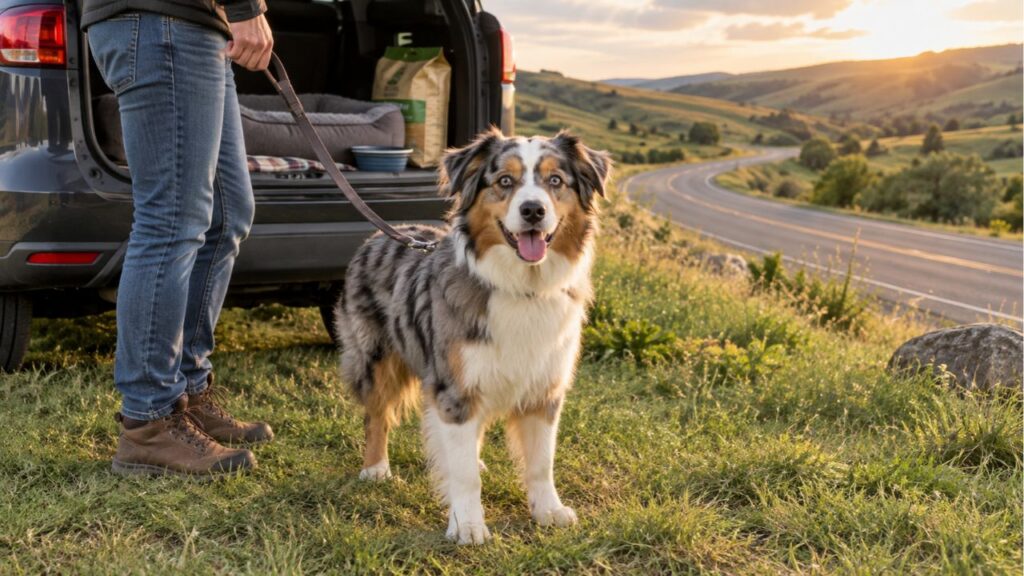
A road trip with a dog can be an incredible adventure, or eight hours of high-pitched whining, carsickness, and frantic searches for safe rest stops.
The difference comes down to managing three basic friction points: stop timing, stomach contents, and physical restraint.
Before packing the car, use this stop-by-stop schedule to plan your driving day:
Trip Phase: Pre-Drive (3–4 hrs out) Rule: Feed light breakfast or skip if carsick; take a long walk.
Trip Phase: In Transit (Every 2–3 hrs) Rule: Stop 15–20 min for water, sniff breaks, and bathroom.
Trip Phase: Car Setup Rule: Back seat only; crash-tested harness or anchored crate.
Trip Phase: Arrival / End of Day Rule: Feed main daily meal once fully settled at destination.
Before anything else
The One Thing Nearly Every Owner Gets Wrong
They let their dog ride loose. Research from AAA and Kurgo found that around 80% of dog owners drive with their dog, but only about 16 to 17% use any kind of restraint. That’s more than 8 in 10 dogs riding loose.
In a 30 mph crash, an unrestrained 10-pound dog hits with the force of roughly 300 pounds. On ordinary drives, about 3 in 10 owners admit their dog has distracted them at the wheel.
The fix: a crash-tested harness clipped to the seatbelt, or a crash-tested crate secured in the cargo area. Back seat or cargo area only, never the front.
Choose a Crash-Tested Restraint →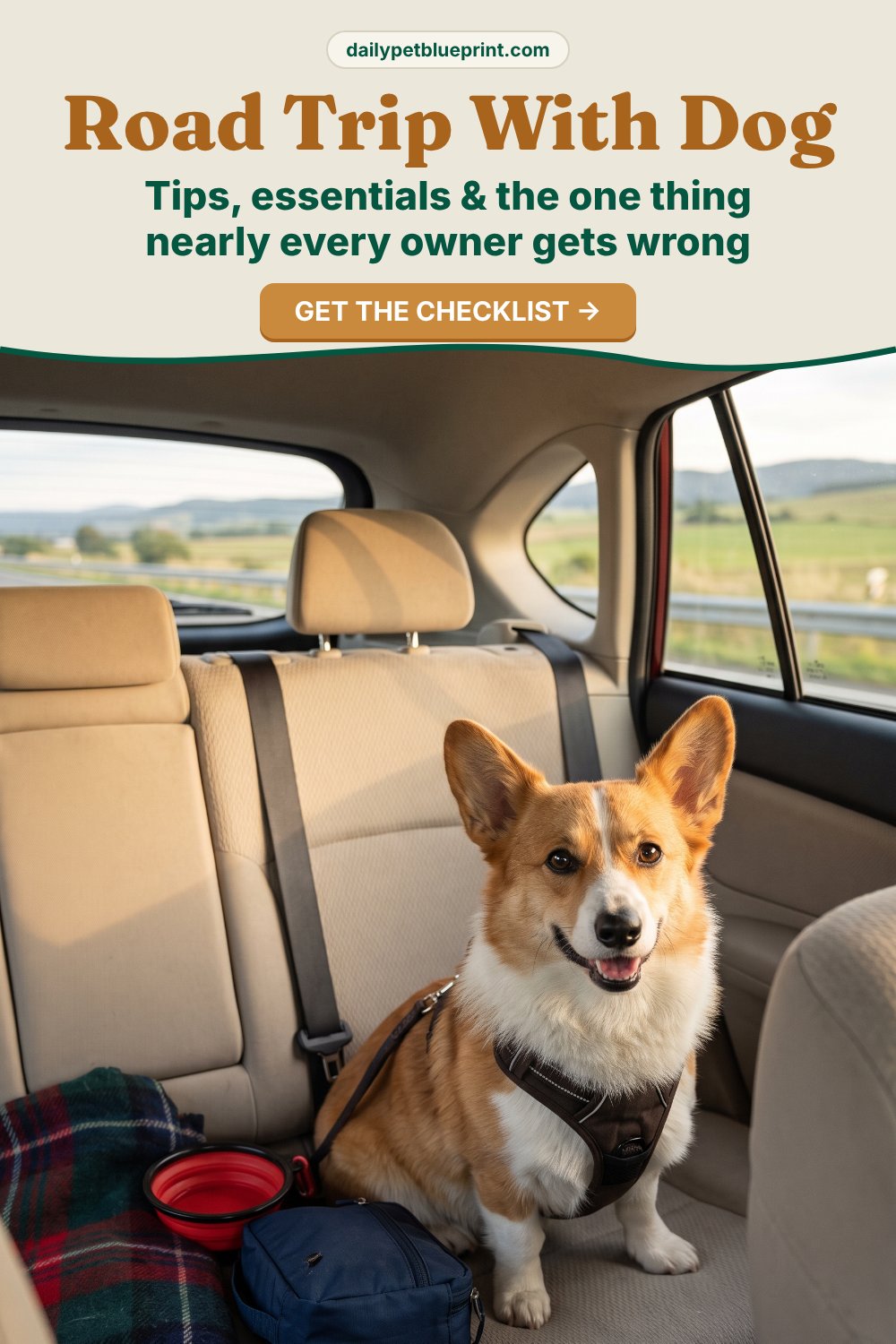
Before You Go On A Long Trip
Practice With Shorter Drives
If your dog only gets in the car to go to the vet, a long trip will feel like a very long vet visit. In the weeks before, take short drives to good places, like a park or a favorite walk, and build up gradually.
This also shows you how your dog handles the car: whether they get sick, how long they settle for, and what helps.
Get a Vet Check for Long Trips
For anything longer than a few hours, especially with a puppy, senior or anxious dog, a vet visit beforehand is worth it. Ask about:
- Car sickness medication, if your dog gets nauseous
- Whether vaccinations and flea, tick and heartworm prevention are up to date for where you’re going
- Copies of vaccination records, including the rabies certificate
- Enough of any regular medication for the trip, plus extra
Update the Microchip and Tag
Check the microchip is registered to you with your current mobile number, and put a tag with that number on the collar. A dog that slips away at a gas station hundreds of miles from home needs every chance of getting back to you.
Plan the Route Around Your Dog
- Mark stops roughly every 2 to 3 hours, ideally parks, rest areas with grass, or dog-friendly trails rather than busy gas stations.
- Book overnight stays ahead and confirm the pet policy. Some “pet friendly” hotels have weight limits or charge per night.
- Note an emergency vet somewhere along each day’s route.
- Check the weather. A heatwave changes everything about where and how long you can stop.
Setting Up the Car
Use a Crash-Tested Restraint
An unrestrained dog is a danger to everyone in a crash. Research from AAA and Kurgo found that an unrestrained 10-pound dog in a 30 mph crash hits with the force of roughly 300 pounds, and a loose dog is a distraction on every ordinary mile too.
A crash-tested harness clipped to the seatbelt or a crash-tested crate secured in the cargo area are the two safe options. See Dog Car Seats and Safety Restraints for how to choose and fit one, or Small Dog Car Seat Safety and Large Dog Car Safety for size-specific advice.
Back Seat or Cargo Area, Never the Front
A front passenger airbag can seriously injure or kill a dog, even a large one. Keep them in the back seat or a secured crate in the cargo area.
Make the Space Comfortable
- A seat cover or hammock protects the seats and stops your dog sliding into the footwell.
- Their own bed or blanket gives them somewhere familiar to settle.
- Sun shades on the rear windows keep direct sun off them.
- Make sure the air conditioning actually reaches the back. Rear seats and cargo areas can be much warmer than the front.
For more ideas, see Dog Car Safety Gear Ideas.
Keep Heads Inside
Dogs love sticking their heads out of the window, but road grit, insects and stones can cause eye and ear injuries at speed. Crack the window a few inches for fresh air instead.
How Often to Stop
Plan a stop every 2 to 3 hours for an adult dog. At each one:
- Let them go to the toilet
- Offer water
- Walk for 15 to 20 minutes so they can stretch and sniff
Puppies need stops much more often. A rough guide is that a puppy can hold their bladder for about one hour per month of age, plus one, so a 3-month-old puppy needs a break about every 3 to 4 hours at most, and often sooner after drinking or waking up.
Senior dogs and dogs with health conditions may also need more frequent stops. Watch for restlessness, whining or pacing in the back. It’s often your dog telling you they need to go.
Safety at Rest Stops
- Clip the lead on before opening the door. A dog that jumps out next to a busy road can be gone in seconds.
- Use a fixed-length lead. Retractable leads give you very little control near traffic.
- Check the ground. Asphalt gets far hotter than the air. Press the back of your hand on it for 5 seconds. If you can’t hold it there, it’s too hot for paws.
- Watch for hazards. Broken glass, spilled antifreeze (sweet tasting and deadly), discarded food and chicken bones are common at rest areas.
- Keep your distance from other dogs. A stressed dog on a long trip may not react the way they do at home.
Feeding and Water on the Road
A full stomach and a moving car don’t mix well. The simplest routine that works for most dogs:
- A small breakfast 3 to 4 hours before you leave, or skip breakfast if your dog gets carsick
- No big meals while you’re driving
- The main meal once you’ve stopped for the day
- Small amounts of water at every stop, rather than a big drink just before setting off
Bring water from home for the first day. Some dogs get an upset stomach from a sudden change in water, and you can mix in local water gradually.
Keep their usual food. A road trip isn’t the time to try a new brand.
Heat: The Biggest Road Trip Danger
Never leave your dog in a parked car, even for a quick stop, even with the windows cracked.
Research from San Francisco State University found that on a 70°F day, the inside of a car reaches about 89°F after 10 minutes and about 104°F after 30 minutes. Cracking the windows makes very little difference.
Ways to avoid ever needing to leave them:
- Travel with another adult so one of you can stay with the dog.
- Use drive-throughs and pay at the pump.
- Pick dog-friendly places to eat, or have a picnic at a park.
- In hot weather, drive in the early morning and evening and rest in the shade at midday.
Learn the signs of heatstroke: heavy panting, thick drool, bright red gums, wobbling, vomiting or collapse. Move your dog somewhere cool, offer small amounts of water, and get to a vet straight away.
Cold matters too. In winter, a parked car turns into a fridge, which is dangerous for small, short-coated and senior dogs.
Car Sickness and Anxiety
Signs of car sickness include drooling, lip licking, yawning, whining and vomiting. It’s especially common in puppies, and many grow out of it.
Things that help:
- Travel on an empty or nearly empty stomach
- Keep the car cool and crack a window for fresh air
- Let your dog face forward rather than watching the scenery blur past the side windows
- Drive smoothly, with gentle braking and cornering
- Take more frequent breaks
- Ask your vet about anti-nausea medication, like maropitant (Cerenia), for long trips
For a dog who whines, paces or panics in the car, see Why Does My Dog Cry in the Car? for how to tell anxiety from sickness and fix each one.
Road Trip With Dog Essentials Checklist
Safety
- Crash-tested harness or crate
- Collar with ID tag and your mobile number
- Fixed-length lead, plus a spare
- Pet first aid kit
- A recent photo of your dog on your phone
Food and Water
- Their usual food for the whole trip, plus two days extra
- Water from home, at least for the first day
- Collapsible bowls for food and water
- Treats for rewarding calm behavior
Comfort
- Their bed or a familiar blanket
- Seat cover or back-seat hammock
- Window sun shades
- A favorite toy and a long-lasting chew
- A cooling mat in summer, a coat in winter
Clean-Up
- Lots of waste bags
- Old towels for wet or muddy dogs
- Pet wipes and paper towels
- Enzyme cleaner and a few plastic bags for accidents or sickness
Health and Paperwork
- Vaccination records and rabies certificate
- Regular medication, plus car sickness medication if prescribed
- Flea and tick prevention
- Your vet’s number and emergency vets along the route
What Goes in a Pet First Aid Kit
- Gauze, non-stick pads and self-adhesive bandage
- Saline for flushing eyes and wounds
- Tick remover
- Blunt-ended scissors and tweezers
- A digital thermometer
- Disposable gloves
- A spare slip lead
- The ASPCA Animal Poison Control number: (888) 426-4435 (a fee applies)
Road Trip Hacks That Make It Easier
- Tire your dog out before you leave. A long walk or a game of fetch first means they’re more likely to sleep in the car.
- Freeze a stuffed rubber toy the night before. It gives your dog something calming to work on during the first hour.
- Keep a “dog bag” within reach. Lead, bags, water, bowl and wipes in one bag on the back seat, so you’re not digging through the trunk at every stop.
- Bring a gallon of water from home. It saves hunting for water at stops and avoids stomach upsets.
- Use a lint roller and a rubber glove. Run the glove over the seats to pull up dog hair fast.
- Pack a “first night” bag. Food, bowls, bed and medication in one bag, so you don’t unpack the whole car at the hotel.
- Put a temporary tag on the collar with the name of where you’re staying.
- Search for dog parks along the route. A fenced area lets your dog stretch properly in a 15-minute stop.
- Use an old fitted sheet over the back seat if you don’t have a seat cover. It tucks in and comes off easily for washing.
- Play calm music or talk radio. Steady background sound can help some dogs settle.
Family Road Trips With Kids and a Dog
A car full of excited children can be a lot for a dog. A few rules make it easier for everyone:
- Give the dog their own space, ideally a crate or a separate row, rather than squeezing them between car seats.
- Agree “dog rules” with the kids before you leave: no feeding snacks, no poking through the crate, and leave the dog alone when they’re sleeping.
- One adult is in charge of the dog at every stop, so they don’t get forgotten in the rush for the bathroom.
- Count heads and paws before pulling away.
- Pick stops with grass and space, so kids and dog can both burn off energy.
- Watch for signs your dog has had enough, like turning away, lip licking or yawning, and give them a break from the kids.
Traveling With More Than One Dog
- Restrain each dog separately, so they can’t tangle or get into a squabble in a confined space.
- Walk them one at a time at busy stops if you’re on your own.
- Check hotel limits. Many pet-friendly rooms allow only one or two dogs.
- Feed them apart at the end of the day. Stress can make food guarding worse.
Overnight Stops
- Confirm the pet policy when you book, not at the desk: size limits, number of dogs, fees, and whether dogs can be left alone in the room.
- Ask for a ground-floor room near an exit for late-night toilet trips.
- Walk your dog before checking in.
- Set up their bed and water first thing, and check the room for dropped pills or cleaning products.
- Don’t leave your dog alone in an unfamiliar room on the first night if you can avoid it.
- Bring the essentials in from the car. Never leave your dog in the car overnight.
When You Arrive
Give your dog a proper walk before anything else, then a quiet hour to explore their new space. Keep feeding and walk times close to normal for the rest of the trip, and expect a day or so of extra tiredness after a long drive. For planning everything around the trip itself, see Traveling With Dogs: Everything to Sort Before You Leave Home.
Small and Large Dogs on the Road
Small dogs get cold faster, need more frequent toilet stops and are easier to lose at a busy rest area. Large dogs need a bigger, sturdier setup and more room to stretch at every stop. See Small Dog Travel Safety Tips and Large Dog Travel Safety Tips for more.
Common Mistakes
Letting the dog ride loose “because they’re good in the car.” Good behavior doesn’t help in a sudden stop.
Feeding a big breakfast before leaving. It’s one of the most common causes of car sickness.
Opening the door before the lead is on. Rest stops next to highways are where dogs go missing.
Leaving the dog in the car “for two minutes.” Lines are longer than you expect, and cars heat up faster than people think.
Driving straight through to save time. A dog who doesn’t get breaks gets restless, sick or anxious, and the trip gets harder for everyone.
Skipping practice drives. A long road trip is a tough first experience for a dog who only knows the car as the way to the vet.
FAQ
How long can a dog travel in a car?
Most healthy adult dogs can manage a full day’s driving, as long as you stop every 2 to 3 hours for toilet breaks, water and a walk. Puppies, seniors and anxious dogs do better with shorter days.
Should my dog ride in a crate or a harness?
Either works if it’s crash tested and fitted properly. A crate suits dogs who are already crate trained and gives them a calm, enclosed space. A harness suits dogs who are happier on the seat. See Dog Car Seats and Safety Restraints for the full comparison.
Can I give my dog Benadryl for a road trip?
Only if your vet says so and gives you the right dose. Some products contain other ingredients that aren’t safe for dogs, and there are anti-nausea medications made specifically for dogs that often work better.
What do I do if my dog gets carsick halfway through the trip?
Pull over somewhere safe, clean up, give your dog a short walk and some fresh air, and offer a little water. Drive the next stretch with the windows cracked and take more frequent breaks. If it keeps happening, talk to your vet before your next trip.
How do I keep my dog calm on a long drive?
Tire them out before you leave, give them a familiar bed, keep the car cool, and offer a frozen stuffed toy for the first stretch. Regular stops help more than anything.
Is it safe for my dog to drink water from rest stop taps?
It’s usually fine, but water from home avoids stomach upsets, especially on the first day. Avoid letting your dog drink from ponds or puddles, which can hold toxic algae or chemicals.
The Bottom Line
A good road trip with a dog comes down to a few habits: a crash-tested restraint, a stop every 2 to 3 hours, light meals on driving days, the lead on before the door opens, and never leaving them in a parked car.
Work through the essentials checklist before you leave, and the drive becomes one of the best parts of the trip.
Traveling With Your Dog
From the first car ride to a road trip or flight, step by step
10 short guides, in the order you’ll need them.
Start hereDog car safety: what actually works →